
Nebraska Driver’s License and Permit Test Practice – 500 Questions
Results
Good job. This is a passing score. Do you want to try another test?
This is not a passing score. Do you want to try again?




#1. The driver ahead signals:
Slowing or stop – left arm extended downward, with palm of hand to the rear.

#2. You approach a stopped emergency vehicle with flashing lights. If it is unsafe to move over or change lanes, you should:
A driver in a vehicle on a multi-lane controlled-access highway approaching a stopped emergency, road assistance, public/private utility maintenance, highway maintenance, or solid waste or recycling collection vehicle with flashing lights must move into a lane at least one travel lane away from the stopped vehicles. If moving into another lane is not possible, due to other traffic or for other conditions, the driver must then reduce their speed and maintain a safe speed past the stopped vehicles.

#3. When backing up or reversing your car:
Place your right arm on the back of the seat and turn around so that you can look directly through the rear window. Do not depend on your rearview or side mirrors, as you cannot see directly behind your vehicle.
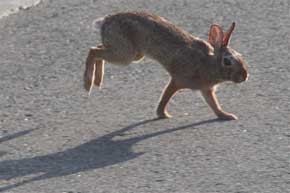
#4. Should a small animal suddenly run out in front of your car, you should:
There may be occasions when an animal suddenly runs in front of your vehicle. Small animals such as rabbits, dogs, or cats seldom cause severe property damage to vehicles, but present a hazard if a motorist takes evasive action that results in losing control of the vehicle. Remember, in passenger vehicles, you are more at risk for death or injury if you swerve to avoid hitting an animal.

#5. When a traffic signal is showing a flashing red light, you must:
A flashing red traffic light means the same as a stop sign. A complete stop is required, yielding to oncoming traffic or pedestrians, before proceeding when the way is clear.
The signal does not change color, it stays red.
A flashing red light at a railroad crossing requires a complete stop even if a train is not visible.

#6. What does the basic speed rule mean?
Nebraska’s speed law requires driving at a speed that is reasonable and safe under existing conditions.

#7. The blood alcohol level at which it is illegal for any person 21 years or older to drive is:
If the tests show an alcohol concentration of .08 or more, you are legally intoxicated. For drivers under the age of 21, it is against the law to drive if your BAC is .02% or higher.
Remember, it is unlawful to operate a motor vehicle on Nebraska roadways if the driver has a Blood Alcohol Concentration (BAC) of:
- .02 percent or higher and the driver is under 21.
- .04 percent or higher when operating a commercial motor vehicle.
- .08 percent or higher regardless of driver’s age or vehicle type.
You can be convicted of DUI even if your BAC is lower.

#8. Three vehicles arrive at an intersection where there are no signs or signals. Vehicle A is turning left. Vehicles B and C are going straight. Vehicle A must:
Vehicle C goes first.
Vehicle A must yield to both B and C.
Vehicle B must yield to vehicle C.
Remember to slow down at an uncontrolled intersection. Look left and right for oncoming traffic and proceed if the way is clear. You must yield the right-of-way to any vehicle that has entered the intersection from your right or is coming from your right.
Look for traffic coming from the left. Make sure that the other driver is yielding before you proceed.

#9. When turning from a side street or driveway into a shared center lane, you must not:
A center lane separated with solid and broken yellow lines reserves a lane for left turns shared with traffic from the opposite direction.
Motorists entering this lane should use caution and may only turn left. Using this lane to pass is prohibited.
Signs and arrow markings on the pavement will assist drivers in recognizing this useful turning lane.
Note: curved arrows pointing in different directions do NOT indicate that the lane should be used for right turns, they indicate left turns from opposite directions.

#10. At night, where is it acceptable to drive with your lights on high beam?
Use high beams on open highways with no oncoming traffic. High beams let you see twice as far as low beams.
Dim your lights when necessary. Do not use high beams in fog or when it is snowing or raining hard.

#11. If you run off the pavement, you can make the situation worse by:
If you run off the road, do not panic.
- Hold steering wheel firmly and steer so wheels straddle the edge of the roadway.
- Do not attempt to turn back onto the roadway immediately.
- Reduce speed.
- Check traffic.
- Gradually turn back onto roadway when it is safe to do so staying in the driving lane.

#12. What does this sign mean?
Stop sign ahead. When you come to this sign, slow down to be ready to stop at the stop sign.

#13. If you have a Nebraska driver's license and move, you must report your new address within:
If your name or address changes, you must apply for a replacement license or ID card within 60 days of such change.

#14. In Nebraska, fines double for speeding in construction and maintenance zones:
Fines are doubled when workers are present in work zones.

#15. When you park on a hill headed downhill, and there is no curb, you should turn your front wheels:
Headed downhill with no curb, turn the wheels to the right or side of the road, so the car will roll away from the center of the road if the brakes fail.
Study the diagram provided in your driver’s manual.

#16. When entering a high-speed roadway or a limited-access highway, it is wrong to:
You should not insist on the right-of-way.
Remember that traffic on a high-speed roadway or a limited-access highway has the right-of-way. You cannot always count on other drivers seeing you or moving over to give you room to enter.

#17. You are driving a vehicle equipped with antilock (ABS) brakes. When you need to stop on snow and ice, you should:
Vehicles equipped with antilock (ABS) brakes: press brake pedal firmly – do not pump brakes.

#18. Which road signs have a green background?
Green is used for guidance information, including: destinations, distances, and directions.

#19. This is:
Regulatory speed limit sign. It indicates the maximum speed that a vehicle can lawfully travel on the roadway.

#20. What does this sign mean?
Merging Traffic sign. You are coming to a point where another traffic lane joins the one you are on. Watch for other traffic and be ready to yield the right-of-way when necessary.

#21. What do the light gray areas in the picture mark?
Your blind spot is the area to the side of a vehicle which cannot be seen in mirrors. A blind spot exist on both sides of your vehicle. When changing lanes or making a turn, glance over your shoulder to be sure no one is in the blind spot.

#22. What does this sign mean?
Low clearance. The overpass has a low clearance. Do not proceed if the vehicle height exceeds the dimensions indicated.

#23. It is illegal to park a vehicle if a yield sign is within:
Do not park within 30 feet of any flashing signal, stop sign, yield sign or other traffic control device located at the side of the roadway.
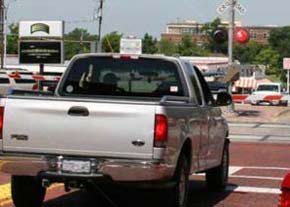
#24. When you are required to stop at a railroad crossing and there is no stop line, you must keep this distance from the nearest rail:
When required to stop, stop at the stop line. If none, a stop must be made within 50 feet but not less than 15 feet from nearest rail. You may not proceed until you can do so safely.

#25. A vehicle carrying this sign operates at a speed of:
Vehicles which travel 25 mph or less, such as farm equipment, must display these standard triangular slow moving vehicle emblems.
Nebraska DMV Written Test
Quick facts about your DMV driver’s license test in Nebraska:
| Number of Questions: | 25 |
| Correct answers needed: | 20 |
| Passing score: | 80 percent |
| Time limit: | None |
| Earliest retest upon failure: | 1 day |
500+ Nebraska Permit Test Questions
This practice test for a Nebraska Driver’s License or Learner Permit has 25 questions randomly drawn from a database with more than 500 DMV questions.
After each question, you will get feedback and brief explanations if your answer is wrong.
The practice test is specifically designed to help you pass the Nebraska written DMV exam, which means that answers are not always applicable to other state tests.
You should get a copy of the Nebraska Driver’s Manual to study for your written exam. If you are enrolled in an approved driver education, a copy is usually provided as part of your education. You can also get a copy from any Nebraska DMV service center or download a copy online at dmv.nebraska.gov .
Everything you need to learn for your NE written test is found in this manual.
The Nebraska Written Permit Test
Like this sample test, the actual written test has 25 random questions.
You need 20 correct answers to pass your examination (a passing score of 80%).
If you fail your test, you must wait at least one day before you can retake it.
There is no time limit on the written test, which means that you should take your time och carefully read questions and all choices before you answer. Being over-confident and answering too quickly is the most common reason people fail the test.
Is the Nebraska DMV Test Hard?
The Nebraska DMV test is known to be challenging. About half of all first-time test takers fail the exam, and we grade the difficulty level as hard.

Study the Driver’s Manual more than once, and if you take the test for a permit, don’t forget to learn the restrictions that will be placed on your permit.
As a teenager, you should also be aware of the risks you face as a new young driver, including impaired driving and using cell phones while driving. Contrary to popular belief, most teen crashes are not caused by aggressive driving or thrill-seeking. Instead, they are more often caused by errors associated with inexperience.
Nebraska Re-examination
When you renew your license or transfer an out-of-state license to a Nebraska Driver’s License, the knowledge test is usually waived at the discretion of DMV personnel.
However, DMV will ask for a new knowledge test in some situations. You will be notified ahead of such a test.
Use these practice tests to verify whether you are ready for a real test.
