
Montana Written Knowledge Test | MT MVD Test Practice
Results




#1. What does the three-second rule mean?
To avoid tailgating, use a three-second rule. When the vehicle ahead of you passes a certain point such as a sign or a tree, count one-thousand-one, one-thousand-two, one-thousand-three. This takes about three seconds. It gives you time and distance to respond to problems in the lane ahead of you.

#2. You can drive in a lane marked with this sign if you are:
HOV stands for High Occupancy Vehicles and indicates lanes reserved for vehicles with more than one person in them. Signs say how many people must be in the vehicle, as well as the days and hours to which it applies. For example, HOV 3 means that there must be at least three people in the vehicle.

#3. If your vehicle is hit from the rear, your body will be thrown:
If your vehicle is hit from the rear, your body will be thrown backward. Press yourself against the back of your seat and put your head against the head restraint. Be ready to apply your brakes so that you will not be pushed into another vehicle. Your lap and shoulder belts will help minimize your vulnerability to injury.

#4. If you are traveling in lane B (beneath a steady yellow X), you must:
Some travel lanes are designed to carry traffic in one direction at certain times and in the opposite direction at other times.
- A green arrow means you can use the lane beneath it.
- A red X means that you may not.
- A flashing yellow X means the lane is only for turning.
- A steady yellow X means that the use of the lane is changing, and you should move out of it as soon as it is safe to do so.

#5. You approach a stopped emergency vehicle with flashing lights. If it is unsafe to move over or change lanes, you should:
To pass a traffic stop or crash, you should slow down, signal, and move into the passing lane, unless otherwise directed by law enforcement or other authority. You must pass with caution and at a speed that is not faster than is reasonable and proper under the conditions.
Montana Move Over Law states that you upon approaching a stationary authorized emergency vehicle or police vehicle must reduce the vehicle’s speed, proceed with caution, and, if possible, considering safety and traffic conditions, move to a lane that is not adjacent to the lane in which the authorized emergency vehicle or police vehicle is located or move as far away from the authorized emergency vehicle or police vehicle as possible.

#6. Emotions affect your driving. If you are excited or angry, it is a good idea to:
If you are angry or excited, give yourself time to cool off. Take a short walk if necessary, but stay off the road until you have calmed down.
Remember, emotions can have a great effect on your driving safely. You may not be able to drive well if you are overly worried, excited, afraid, angry, or depressed.

#7. To check your blind spot when changing lanes to the left, you should glance:
Look over your shoulder in the direction you want to move. Be sure no one is near the left or right rear corners of your vehicle. These areas are blind spots. To see the blind spots, you have to turn your head and look.
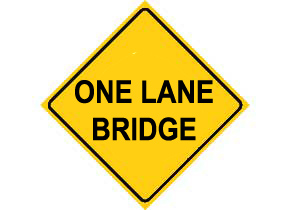
#8. This sign tells you that the bridge ahead:
The bridge ahead has only one lane. There is not room on the bridge to meet or pass another car or truck.
The lane must be shared by traffic from both directions. Temporary traffic signals might be installed, or a flagman stationed to direct and let traffic take turns using the single lane bridge.

#9. At an uncontrolled intersection, a pedestrian has entered the crosswalk. In this situation, you should:
Always yield the right-of-way to a pedestrian in a marked crosswalk, or at an unmarked crosswalk at an intersection.

#10. Windshields that are dirty will usually:
Keep the windshield clean. Bright sun or headlights on a dirty windshield make it hard to see.

#11. Traffic signs with orange background show:
Orange is used for construction and maintenance warning. The signs are usually diamond shaped. They notify drivers of unusual or potentially dangerous conditions near work areas.

#12. What should you do when approaching a railroad crossing?
As you approach any railroad crossing, slow down, look, listen, and be prepared to stop. Do not assume that a train is not coming even if you have never seen one at that crossing before. That is one of the leading causes of fatalities at railroad crossings.

#13. Before turning left or right in a city, you must signal during the last:
You must continuously during the last 100 feet before turning in any business district, residence district, or urban district.

#14. You want to turn right ahead. There is a bicyclist just in front of you. What should you do?
Motorists may not overtake and pass a person riding a bicycle unless it can be done without endangering the person riding on the bicycle. Trying to pass a bicyclist just before a turn is dangerous.
When a bicycle is traveling in your lane and you need to make a right-hand turn, always check to make sure the bicyclist has either stopped to let you turn, or allow the bicyclist to pass you before making the turn.

#15. If you miss your exit when leaving a controlled-access highway, you should:
If you miss your exit, take the next one.

#16. What does this sign mean?
Sharp Turn. Road ahead makes a sharp turn in the direction of the arrow (right). Slow down, keep right, and do not pass.
Note the difference between a curve to the right and a sharp turn to the right.

#17. Anti-lock brakes are of most use when you are:
One aspect of having Anti-Lock Brake Systems (ABS) is that you can turn your vehicle while braking without skidding. This is very helpful if you must turn and stop or slow down.
In general, if you need to stop quickly with ABS you must press on the brake pedal as hard as you can and keep pressing on it. You might feel the brake pedal pushing back when the ABS is working. Do not let up on the brake pedal. The ABS system will only work with the brake pedal pushed down.

#18. If your vehicle breaks down on a highway and you cannot move it off the road:
If your vehicle breaks down on a highway, make sure that other drivers can see it. All too often crashes occur because a driver did not see a stalled vehicle until it was too late to stop. Try to stop where other drivers have a clear view of your vehicle if you cannot get your vehicle off the roadway. (Do not stop just over a hill or just around a curve.)
Turn on your emergency flashers to show you are having trouble. If you have them, place emergency flares behind the vehicle.

#19. When should you give a sharp blast on your horn?
If there is danger, do not be afraid to sound a sharp blast on your horn. Do this:
- When a child or older person is about to walk, run, or ride into the street
- When another vehicle is in danger of hitting you
- When you have lost control of your vehicle and are moving towards someone

#20. One primary factor that affects how impaired a person will become when consuming alcohol is:
The lower the weight of the drinker, the lower the amount of alcoholic beverage it takes to bring the blood alcohol concentration to a specified level.
How impaired a person will become when consuming alcohol mainly depends on:
- The amount of alcohol consumed
- How fast it is consumed (time spent drinking)
- A person’s body weight.
- A person’s general health.
It takes about half as much for a person weighing 100 pounds as for another weighing 200 pounds.

#21. When turning right, you must:
When turning right, signal your turn at least 100 feet ahead. Yield to pedestrians and crossing bicyclists.

#22. What color is a curb where you cannot stop, stand, or park?
A red curb means no stopping, standing, or parking.

#23. Trucks and buses have:
Never stay alongside a large vehicle such as a truck or bus. These vehicles have large blind spots, and it is hard for their drivers to see you. The blind spots exist on both sides, particularly alongside the cab, to the rear and in front of the cab (see illustration in the driver manual).

#24. Montana's General Speed Rule says:
Posted speed limits do not tell you at what speed to drive. You must drive at a speed that is safe for conditions.
Montana Code says you must drive at a speed no greater than is reasonable and prudent under the conditions existing.

#25. You approach this road sign. It means:
Keep right. A divided highway or traffic island where traffic must keep right is ahead. Stay on the right side of the divider.
#26. You are driving on an interstate when you suddenly have a flat tire. What should you do?
If a tire suddenly goes flat, hold the steering wheel tightly and keep the vehicle going straight. Slow down gradually. Take your foot off the gas pedal and use the brakes lightly. Do not stop on the road if at all possible. Pull off the road in a safe place.
Remember, if one of your tires becomes flat or you have a blowout, you might lose control of your vehicle.

#27. You are driving on a two-way road with one lane in each direction. Passing another vehicle on the right is only allowed if:
Passing on the right is legal only when the vehicle you are passing is making or about to make a left turn, or on a road with unobstructed pavement wide enough for two or more lanes of vehicles legally going in the same direction as the vehicle you are passing.
Remember, if you pass on the right, the other driver may have difficulty seeing you and might suddenly change lanes in front of you.

#28. Which light indicates that unprotected turns are permitted?
A flashing yellow arrow means left turns are allowed, but you must first yield to oncoming traffic and pedestrians. Oncoming traffic has a green light. You must determine if there is a safe gap before turning.

#29. This red and white sign means:
The do not enter sign usually tells you that the road or street ahead is for one-way traffic traveling in the opposite direction. You must not enter the street so marked. It may be a one-way street in the opposite direction, or all vehicular traffic may be prohibited.

#30. When a school bus displays yellow flashing lights, it tells you:
A school bus displaying a yellow flashing light is about to stop and children may be in the road. Slow down and proceed carefully.
Upon meeting or passing from either direction any school bus stopped with its red lights flashing, you must stop at least 30 feet from the bus. You cannot proceed until the red lights are turned off.

#31. When is it recommended that you adjust your speed to a crawl?
If there is snow or ice on the road, slow down. On packed snow you should cut your speed in half. Use snow tires or chains when the road is covered with snow. On ice, you must slow to a crawl. It is very dangerous to drive on ice.

#32. The second step of the Graduated Driver License program is:
The GDL program includes an instruction permit, first-year restricted license, and full-privilege driver license. Each step is designed to progressively increase the skills, privileges, and responsibilities of a new driver.

#33. When you want to make a right turn at an intersection with a steady red light, you should:
A steady red signal means stop.
When entering a two-way street, you may cautiously turn right after stopping. You may make the right turn unless a sign or police officer tells you not to turn against the red light.
When entering a one-way street from a one-way street, you may also turn left after stopping.
Montana MVD Written Test
Quick facts about your driver’s written exam in Montana:
| Number of Questions: | 33 |
| Correct answers needed: | 27 |
| Passing score: | 82 percent |
| Time limit: | None |
| Earliest retest upon failure: | No official rule |
500+ Montana Test Questions
This Montana practice test has 33 questions to help you pass the written knowledge test for a learner’s permit or full driver’s license.
Like the real written test, this practice test pulls random questions from a large pool of exam questions, making each set of questions unique and allowing you to practice until you feel comfortable with all answers.

Study the Montana Driver Manual
Everything on your written knowledge test is based on the information you can find in the Montana Driver Manual issued by Montana Motor Vehicle Division (MVD).
The easiest way to pass your knowledge test is to get the latest version of the manual. If you sign up for driver education, they will provide you with a copy. You can also get a copy from any MVD service center or download a PDF-version online .
Reading the manual is a must. You are less likely to pass your exam without a good understanding of Montana traffic laws and common rules of the road.
Written Test Practice
The purpose of the written test practice is to help you study and prepare for the actual examination.
You need to correctly answer 27 of the 33 multiple-choice questions on the exam. That is a passing score slightly above 80%, which is higher than in most states .
The failure rate on the Montana written test is also higher than in many other states.
So, it is a good idea to prepare well for the test.
Take a few practice tests per day over a week, and you will probably see how your score improves over time.
Focus on understanding questions and answers; don’t rush through each test to get a passing score.
The Real Montana Written Exam
When new drivers fail the exam, they often say they didn’t read carefully enough. It is common to be nervous before the test and want to get it over with, and slowing down can help you stay focused.
Read the directions thoroughly and carefully read all answers before making a choice. Nothing is worse than realizing you missed a question because you picked an answer too quickly.
This is especially true if you see the old-fashioned test choices like “none of the above” or “all of the above” on your exam. Creators of multiple-choice tests tend only to use these options when there are many things you should do or many things you must not do. Ask yourself if there are several possible answers to the question. There usually is.
There is no time limit on the test, so you are not in a hurry. Most test takers finish in about 15 minutes.
If you fail your exam, you can retake it the next day if there are available appointments or if your examiner allows you to do so. Sometimes, it can be wise to wait just a few more days. You don’t want to fail the test twice.
The Montana written test is a close-book test. You cannot use your manual, notes, or electronic devices during the test.
Montana MVD does not offer home testing; you take the test as part of driver education or at an MVD office.
Is the Montana Written Test hard?
The failure rate is approximately 30%. The difficulty level is graded “moderate.”

A Montana Driver’s License is a Privilege
Remember these points about your MT Driver’s License or Learner’s Permit.
A driver’s license is a privilege, not a right, and the privilege comes with responsibilities.
Anyone who drives a motor vehicle on public roadways in Montana must have a driver’s license (or learner license)
You may have only one valid license at any time.
You must always have the license in your possession when you drive.
It is against the law to loan your license to anyone.
When you move to Montana and become a resident, you must get a Montana driver’s license within 60 days.
A Montana Class D driver’s license is valid for a maximum of four to eight years.
The Montana Graduated Driver Licensing Program
Like all other states, Montana has a Graduated Driver Licensing (GDL) program, affecting all new drivers under 18 years.
GDL is a three-step progressive program that allows new drivers to develop and improve their driving skills over time. By introducing driving restrictions such as night curfews and passenger restrictions, the program helps reduce the crash risk for teen drivers.
GDL Step 1: The Instruction Permit
You must be at least 14 years, 6 months
If you are enrolled in or have successfully completed a state-approved traffic education program, you can get your permit as part of the program when you are 14 ½ years old.
Without a traffic education program, you can get a learner license from a driver exam station if you are 16 years old.
You must pass the written test
You must pass a vision screening and the written test. You cannot have been found by a court to be mentally incompetent, alcoholic, or a habitual user of illegal drugs.
You cannot drive alone
With a learner license, you cannot drive alone, and you must always be supervised by a licensed parent or guardian or a licensed adult driver authorized by the parent or guardian.
You should apply for a learner license at the MVD if other licensed adults should be allowed to supervise your driving during this phase.
You must practice driving for at least 50 hours
With your learner license, you must log at least 50 hours of supervised driving, at least 10 hours at night.
You must hold the learner license for 6 months
Before applying for a first-year restricted license, you must hold your learner license for at least six months or until you are 18 years old.
All occupants must wear seat belts
GDL Step 2: First-Year Restricted License
The first-year restricted license is also known as an intermediate license.
If you are under 18 years old, you can apply for this license if you have held your learner license for at least six months and completed step 1, including 50 hours of supervised driving.
You cannot have traffic violations or alcohol/drug offenses in the six months before advancing to this step.
The license comes with the following restrictions:
You cannot drive alone at night
You cannot drive unsupervised between 11:00 pm and 5:00 am. This rule has limited exceptions, like going to and from work.
You can drive with only a limited number of non-family passengers under 18 years
For the first six months, you can drive with only one non-family passenger under 18 years. During the second six months, you can drive with no more than three non-family passengers under 18 years.
The passenger restrictions don’t apply if you are supervised by a licensed parent or guardian or a licensed adult driver whom the parent or guardian authorizes.
All occupants must wear seat belts
GDL Step 3: Full-Privilege Driver’s License
The first-year restricted license restrictions automatically end on the date indicated on the back of the driver’s license (typically, one year) or when the individual turns 18 years old, whichever occurs first.

