
Washington Written Test Practice – Licensing Answers 2026




#1. When making a right turn, it is wrong and unsafe to:
Avoid swinging wide to the left before making the turn. If you swing wide, the driver behind you may think you are changing lanes or going to turn left and may try to pass you on the right. If you swing wide as you complete the turn, drivers who are in the far lane will not expect to see you there. Complete your turn in the right lane.
This question asked what you should NOT do.

#2. If your brakes suddenly stop working, what is the first thing you should try?
If your brakes stop working, pump the brake pedal several times. This will often build up enough brake pressure to allow you to stop.

#3. If you want to turn left in the path of an oncoming motorcyclist who signals a right turn, you should:
Most motorcycles do not have turn signals that turn off automatically. At times, motorcycle riders may forget to switch the signal off. Before you make a turn in front of a motorcycle with a signal flashing, be sure the motorcycle is turning and not continuing straight into your path.

#4. Which is true about signaling before making a sudden stop?
Always signal when you slow down or stop. Normally, your brake lights let people know that you are slowing down. You may also use hand signals when signal lights cannot be seen by other drivers.

#5. The eight-sided shape is used for which road signs?
An eight-sided sign that is red with white letters means stop.

#6. Washington has a primary safety belt law, which means that:
The Occupant Protection law in Washington State is primary enforcement, meaning a law enforcement officer can stop and cite drivers when they or their passengers are seen to not be wearing their seat belt.

#7. If you have a tire blowout while driving, you should:
If a tire suddenly goes flat:
- Hold the steering wheel tightly and keep the vehicle going straight.
- Slow down gradually. Take your foot off the gas pedal and use the brakes lightly.
- Don’t stop on the road if at all possible. Pull off the road in a safe place.

#8. How can you find out if a railroad crossing has more than one track?
After a train passes, watch out for a second train. Do not start up until you’re sure no train is approaching on another track. Crossings with more than one train track will often post a sign that shows the number of tracks. These signs warn you that there is more than one track and there may be more than one train crossing. Not all crossings with more than one train track will have these signs so it is important to check for more than one track before crossing.

#9. Whenever you stop your car and go into a store to make a quick purchase, you:
Drivers are responsible for making sure that their vehicle is not a hazard when it is parked. Always set your parking brake when you park. Leave the vehicle in gear if it has a manual transmission or in park if it has an automatic transmission.

#10. You need to check traffic behind you more often when:
Besides watching traffic ahead of you, check traffic behind you. You need to check more often when traffic is heavy. This is the only way you will know if someone is following too closely or coming up too fast and will give you time to do something about it, like change lanes, tap on the brakes, speed up, or slow down.

#11. A white diamond painted on the road surface means:
On various roadways, one or more lanes may be reserved for special vehicles. Reserved lanes are marked by signs stating that the lane is reserved for special use. These lanes often have a white diamond posted at the side of the road or painted on the road surface. The word Transit or Bus means the lane is for bus use only. Bicycle means the lane is reserved for bicycles. HOV stands for High Occupancy Vehicles and indicates lanes reserved for vehicles with more than one person in them (carpool lanes).

#12. When should you give a sharp blast on your horn?
If there is danger, do not be afraid to sound a sharp blast on your horn. Do this:
- When a child or older person is about to walk, run, or ride into the street.
- When another vehicle is in danger of hitting you.
- When you have lost control of your vehicle and are moving toward someone.

#13. Once you have entered a roundabout, you should:
Once inside the roundabout, don’t stop. Follow directions on signs or pavement markings about which lane to use, then stay in your lane. Use your right turn signal when exiting.
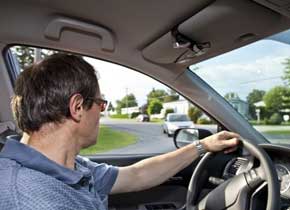
#14. When you cross traffic, you need room to get across. Stopping halfway across is only safe when:
When you cross traffic, you need room to get across. Stopping halfway across is only safe when there is a median divider large enough for your vehicle. Do not stop in a divider where part of your vehicle is sticking into traffic.

#15. When driving at night, be sure that you can stop:
It is harder to see at night. To drive safely at night, slow down and drive within the range of the vehicle’s headlights. You must be able to stop within the distance you can see ahead with your headlights.

#16. This sign alerts drivers in advance of:
Deer crossing. This sign tells you that you are near an area where wild animals can cross the road. Slow down and be prepared to stop.

#17. Failing to settle a civil court judgment resulting from a collision can result in a suspension for:
Failing to settle a civil court judgment resulting from the collision can result in a suspension for 13 or more years.

#18. Which is true about following another vehicle too closely?
Rear-end collisions are very common. If you follow too closely and the vehicle in front of you slows or stops suddenly, you may not have enough time to avoid a collision.

#19. You are on the main highway when you approach this sign. You should:
Added lane sign. Two roadways come together, but you are not required to merge. An additional lane begins. Watch for traffic in the new lane.

#20. When you see a sign with this shape, color, and symbol, you must:
When you see this sign, you must not enter that street or ramp.
The Do Not Enter sign is a square sign with a white horizontal line inside a red ball. It means you cannot enter in that direction.
You will see this sign at roadway openings that you should not enter, such as exit ramps where you would be going in the wrong direction, in crossovers on divided roadways, and at numerous locations on one-way streets.
The Wrong Way sign supplements the Do Not Enter sign. It is placed along the exit ramp or the one-way roadway farther from the crossroad. It tells you that you have already entered a one-way road and are driving in the wrong direction.
Remember, the sign is square, it is not circular!
The Washington State Permit Test
Key numbers for your official Washington Department of Licensing (DOL) knowledge examination:
| Test Questions: | 40 |
| Correct answers needed: | 32 |
| Passing score: | 80% |
| Time limit: | – |
| Earliest retest if you fail: | Same day (driving schools) |

Washington State Written Test
The written knowledge test in Washington is a multiple-choice test with 40 questions; you must correctly answer 32 to pass.
It covers road signs, signals, traffic laws, and safe driving practices described in the Washington Driver Guide.
You should expect the test to take 15-20 minutes, but there is no time limit other than the official closing time. Take enough time to read all questions and answers carefully.
Where Can I Take the Test?
If you are under 18 years, you must enroll in and complete a driver training course to be eligible for a license. Approved driver training schools can offer the knowledge test at their locations.
You also have the option to take the test at the DOL service center if you are 18 years or older or not enrolled in a driver education class. You must pre-apply (online or at a service center) before you can take a test at the DOL.
Washington DOL does not offer the knowledge test online.
Can I Take the Test in Another Language?
The computerized test is available in a few additional languages besides English:
Available Languages
| Chinese |
| Japanese |
| Korean |
| Russian |
| Spanish |
| Vietnamese |
Is the Written Test in Washington Hard?
The written knowledge test in Washington is known to be difficult, and almost one out of two test-takers fail the exam.

Will Practice Tests Help Me Pass the Exam?
All research and every survey confirm that practice tests help.
To get the most out of them, you should use them wisely. A common mistake is to rely solely on practice tests and try to memorize questions and correct answers.
To pass the examination, you must also study the Driver Guide. Everything you must learn for the test is described in this guide. You will get a hard copy as part of your driver education class. Otherwise, you can get a copy from any DOL center or download a PDF-version online .
However, this guide’s rules and best practices are suitable for your exam and will help you become a better driver. Remember that learning to drive and understanding the road rules will help make traffic and Washington highways safer.
The practice tests work best in combination with the Driver Guide. During each study session, use both.
How Many Times Can I Take the Practice Test?
This practice test pulls random questions from an extensive database, making every set of questions and answers unique.
You can take the practice test as often as you like until you feel comfortable with all the facts and are ready to take the examination.
There is no limit and no costs involved.
Why are there Less Questions on the Practice Test?
We have cut the practice tests in half. Each practice test has 20 questions instead of 40.
But don’t worry, all essential facts from the driver guide are covered in these questions. By taking a handful of shorter tests, you can still check your readiness for the exam.
What Happens if I Fail the Test?
If you take your test through an approved school, you can usually take it again the same day. However, there is a waiting time and a new fee for a third attempt.
When you take your test at a DOL service center, examiners have complete discretion in deciding on a waiting time.

FAQ – Learner’s Permit & Driver’s License
At what age can I apply for a learner’s permit?
If you are at least 15 years old and have a WDL number, you can enroll in a driver education course.
You must be at least 15½ years to get your first instruction permit.
What is a WDL number?
All Washington permits, ID cards, and driver’s licenses have a unique number that starts with “WDL.”
You must have a WDL number if you are starting a driver training course or making an appointment to visit a DOL service office. If you have an ID card, you already have the WDL number. Otherwise, DOL will assign one to you when you apply for a permit or license (you can do this online).
What is a driver training program?
A driver training program is a course of instruction in traffic safety education approved and licensed by the Washington Department of Licensing.
The driver training program must include all of the following:
- A total of 30 hours of classroom instruction, with a maximum of 2 hours per day.
- A minimum of 6 hours of practice driving, with a maximum of 1 hour per day.
- A minimum of 1 hour of behind-the-wheel observation.
Online traffic safety education classes are not approved courses in Washington State.
Who must complete a driver training program?
All drivers under 18 must complete a driver training program to earn a driver’s license.
A teen can enroll in driver training when they are 15 years old.
The driver training course is not required if you are 18 or older.
Which Documents do I need to apply for a WA license or learner’s permit?
As a first-time applicant, you must provide proof of the following:
- Identity and date of birth
- Citizenship or legal presence
You must also provide your Social Security number if you have one.
If you are under 18 years, you must also have a parent sign the parental authorization form or an affidavit form.
For a list of acceptable documents, visit dol.wa.gov .
What are the restrictions on Washington instruction permit?
You must always be accompanied by a licensed driver in the front passenger seat. The supervising driver must have at least five years of driving experience.
You cannot use a cell phone while driving unless it is used to call 911.
All passengers must wear seat belts, regardless of seating position or age.
Under no circumstances can you drive on your own when you hold a learner’s permit.
How long must I hold a Washington instruction permit?
You must hold the instruction permit for at least six months before applying for a driver’s license.
How many hours of driving practice is necessary to get a license?
To earn your Washington driver’s license, you must complete at least 40 hours of daylight and 10 hours of night driving (50 hours).
