
Virginia DMV Written Test Practice – 2026 Knowledge Test
Results
You got a passing score. Do you want to try again?
This is not a passing score. Do you want to try again?




#1. When an oncoming car is on your left and a child on a bike is on your right on a narrow road, you should:
Pass only when safe. Instead of driving between the car and the child, take one danger at a time. First, slow down and let the car pass. Then, move to the left to allow plenty of room (at least three feet) before you pass the child.
Remember, slow down when you approach bicyclists. State law requires motorists to pass cyclists with at least three feet of clearance. Give them plenty of room when passing and be prepared to stop suddenly. Look for bicycles on all public roads.

#2. If you fail to pay your court fines and costs within 30 days after a traffic or criminal conviction:
If you are convicted of any traffic or criminal offenses and you fail to pay your court fines and costs within 30 days, the court will suspend your driving privilege. The court may offer you the option to enter into an installment payment agreement if you are unable to pay the total amount.

#3. What do the light gray areas in the picture mark?
Blind spots are danger areas where vehicles around you cannot be easily seen. Before driving, adjust your vehicle’s mirrors. Make sure the inside rear-view mirror frames the entire back window. Adjust both side mirrors so you can barely see the sides of your vehicle.
The best way to see a car in your blind spot is by quickly turning your head and glancing over your shoulder to ensure the way is clear before changing lanes or passing another vehicle.
Avoid driving in someone else’s blind spot. This can be just as dangerous as not checking your own blind spot. Speed up or drop back – but don’t stay in the other driver’s blind spot.
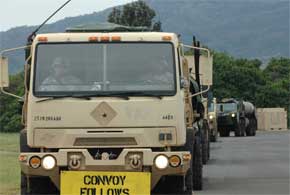
#4. You must yield the right-of-way:
You must yield to all military convoys. Never cut through or join a military convoy.

#5. To reduce the risk of hand, wrist, or arm injury if the airbag is deployed, it is a good idea to grip the steering wheel:
Your grip on the steering wheel is important. If your steering wheel were a clock, your hands should be at the 8 o’clock and 4 o’clock positions. Hold the wheel with your fingers and thumbs. Avoid gripping it with your palms. Gripping the steering wheel as described diminishes the risk of hand, wrist, or arm injury if the airbag is deployed.
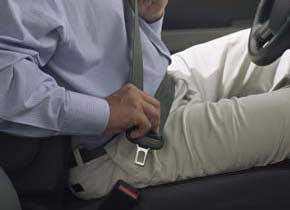
#6. True or false. Persons operating vehicles with airbags are not required to use a safety belt.
Persons in vehicles equipped with airbags are not exempted from the safety belt law.

#7. Unless otherwise posted, what is the legal speed limit in a residential district?
Legal speed limit in school zones, business or residential districts is 25 mph.

#8. If your vehicle has an Anti-Lock Brake System (ABS) and you need to stop quickly, you should:
With ABS, you should put maximum pressure on the brakes and retain steering control without pumping the brakes.

#9. A posted speed limit of 65 mph means that you may drive 65 mph on that highway under all conditions.
Never drive faster than weather, road or other conditions safely allow, regardless of the posted speed limit. Depending on existing conditions, you must slow down enough to be able to see clearly and stop quickly in traffic. Failure to do so can result in a moving violation.

#10. When you park your car on the same side as an entrance to a fire station, you must keep this distance from the driveway entrance:
Never park within 15 feet of the entrance to a fire, ambulance, or rescue squad station.

#11. Lane use signals indicate lanes:
Lane use signals indicate lanes where you can and cannot drive during different hours of the day.

#12. What is the No-Zone in terms of driving?
There are danger areas around large vehicles where crashes are more likely to occur. These areas are called No-Zones. No-Zones on the side, front and rear also include blind spots where your car disappears from the driver’s view. Learning the No-Zones can save your life

#13. When making a right turn you must:
When turning right, you must be in the extreme right-hand travel lane or a lane designated for right turns. Signal your turn at least 100 feet ahead. Yield to pedestrians and bicyclists.
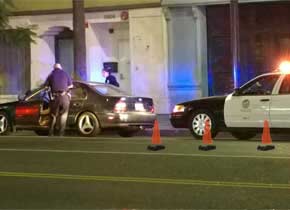
#14. If you are convicted of exceeding the speed limit in a highway work zone, you may be fined up to:
If you are convicted of exceeding the speed limit in a highway work zone, you may be fined up to $500.

#15. If there is a deer on or near the roadway:
Slow down if you see a deer near or crossing the road. Deer frequently travel in groups, there are likely more deer nearby.

#16. When are you allowed to pass a school bus?
You must stop for stopped school buses with flashing red lights and an extended stop sign when you approach from any direction on a highway, private road, or school driveway. Stop and remain stopped until all persons are clear, and the bus moves again.
You must also stop if the bus is loading or unloading passengers and the signals are not on.
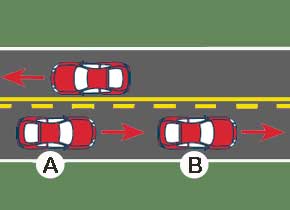
#17. In this picture, car A may pass the vehicle ahead:
Yellow lines mark the center of a road used for traffic going in opposite directions. Broken yellow center lines mean that passing on the left is allowed in either direction when the way ahead is clear.

#18. In Virginia, right turns against a red arrow are:
Virginia law prohibits right and left turns at red arrow lights. If you are traveling in another state, make sure you know its laws for right and left turns at red and red arrow lights.

#19. Which of the following freeze first when wet?
Watch for ice on bridges and in shady areas. Bridges freeze before other road surfaces.
Always approach bridges, shaded spots, overpasses and turns slowly.

#20. Before making a left turn, you should always check for motorcyclists because:
Look for motorcyclists. In more than half of all crashes involving motorcycles and automobiles, the other driver didn’t see the motorcycle until it was too late. Drivers are conditioned to look for four-wheeled vehicles – but they don’t expect to see two-wheeled vehicles. A motorcycle’s small size also makes it difficult to see.
Check your blind spots. A motorcycle’s small size allows it to slip into your blind spot easily. Always check for motorcycles before you pull out, change lanes, turn, back up or proceed through an intersection.

#21. If using a child restraint would be unreasonable, a waiver of the child restraint law may be granted by:
A waiver of the child restraint law may be granted by a licensed physician if using a child restraint would be unreasonable due to the child’s weight, physical fitness, or other medical reasons.

#22. During foggy weather, a driver should turn on the vehicle's high-beam headlights to increase the field of vision.
Fog reflects light and can reflect your own headlights back into your eyes. Use your low-beam lights when you encounter fog, dust, heavy rain, or snow.

#23. You approach an intersection with a red light. Where must you stop?
When required to stop because of a sign or light, come to a complete stop at the stop line or, if there is no stop line, before entering the intersection or before reaching the crosswalk.

#24. Which vehicles must always stop before crossing railroad tracks?
Some vehicles, such as school buses or vehicles carrying hazardous materials, must always stop at railroad crossings. When driving behind one of these vehicles, a motorist must be prepared to stop, even if signals do not indicate a train is coming.

#25. Generally speaking, twelve ounces of beer is the same as:
Twelve ounces of beer is the same as a shot of liquor or a five oz. glass of wine.
The Virginia DMV Permit Test
Key numbers for your official two-part Virginia DMV knowledge examination:
| Test Questions: | 10 + 25 = 35 |
| Correct answers needed: | 10 + 20 = 30 |
| Passing score: | 100% / 80% |
| Time limit: | – |
| Earliest retest if you fail: | 1-15 days (three failures) |
Virginia Two-Part DMV Test
The Virginia written DMV test for your first learner’s permit or an unrestricted driver’s license is a two-part examination.
In the first part, DMV checks your knowledge of common road signs. They will show you ten road signs, which you must be able to recognize by shape, colors, symbols, or messages. You must have ten correct answers on this part before moving on to the second part of the examination.
Check your road sign knowledge here: Virginia highway signs
The second part has 25 multiple-choice questions about Virginia traffic laws, common road rules, and safe driving. On this part, you can miss five questions (20 correct answers), a passing score of 80%.
This Virginia DMV Practice Test
This VA DMV practice test focuses on the second part of the exam.
It has 25 questions, covering everything from pavement markings and traffic signals to impaired driving and the use of child restraints.
The test is random, drawing questions from a larger bank of questions and giving you plenty of opportunities to cover all the essential items in the Virginia Driver’s Manual.
After each question, immediate feedback tells you if your answer is correct. Your final score will be displayed at the end of the test.
Aim for the perfect score of 100% on each practice test.
The Virginia Driver’s Manual
First, don’t rely solely on online practice tests; they can never replace the vital information in the Virginia Driver’s Manual.
Get yourself a copy of the manual before you start practicing. It is an essential read and a perfect guide when you stumble upon questions you don’t know the answer to.
Remember that the Virginia DMV considers the facts in this manual for your knowledge exam. You will not get questions about driving rules not described in the manual.
Use practice tests as a study help and a supplement to the manual, not vice versa.
The Real Virginia DMV Written Test
As a teenager, you will likely take the test as part of your mandatory driver’s education course. You can also take the test at any DMV service location.
Virginia DMV does, however, currently not offer the test online from the comfort of your home.
As mentioned, it is a two-part examination. You must pass a road sign test before taking the 25-question road rules test.
The DMV and schools offer the test on a computer. If you have trouble reading, you can ask for audio support and a headset.
Applicants with needs or special help should always let a DMV staff member know before the test starts. After you have started the test, DMV staff cannot give you additional explanations or help.
The test usually is available in several languages.
Available Languages
| American Sign Language |
| Amharic (Ethiopian) |
| Arabic |
| Chinese/Mandarin |
| Chinese (Traditional) |
| Dari |
| English |
| Farsi |
| French |
| German |
| Haitian Creole |
| Italian |
| Japanese |
| Korean |
| Kurdish |
| Mongolian |
| Nepali |
| Pashto |
| Punjabi |
| Russian |
| Spanish |
| Thai |
| Twi (Akan) |
| Turkish |
| Urdu |
| Vietnamese |
If you fail the test, you must wait 15 days before you can try again – unless you are 18 years or older.
Students who are 18 years old may retake the test the next day at an additional testing fee.
If you fail the examination three times, you must complete an 8-hour Driver’s Manual course in a classroom or online before making a fourth attempt.
Instead of the 8-hour Driver’s Manual course, you can retake (or complete) the classroom component of the driver education course.
Do Not Try to Cheat
The Virginia Knowledge examination is a closed-book test.
You cannot use the Driver’s Manual, books, notes, a cell phone, or any electronic devices during the exam.
Trying to get help from another person or helping someone during the test is also considered cheating.
If you are found cheating, your test will be terminated.

FAQ – Virginia DMV Test & More
At what age can I get a Virginia Learner’s Permit?
You can submit your application for a learner’s permit when you are 15½ years old.
As long as you are under 18, you must also provide written consent from one of your parents or legal guardians unless you are married or emancipated.
At what age can I get a Virginia Driver’s License?
You must be at least 16 years and three months old to qualify for a Virginia driver’s license.
Must I take a Driver Education Course to get a permit?
If you are under 18 years old, you must always complete a state-approved driver education program.
If you are 18 years or older, you can bypass the driver education program by holding a learner’s permit for at least 60 days before taking the DMV road skills test.
Which Documents do I need to apply for a license or learner’s permit?
As a first-time applicant, you must always provide proof of the following:
- Identity
- Citizenship or legal presence
- Virginia Residency
You must also provide your Social Security number if you have one.
If you are under 18 years old and unmarried or emancipated, you must also have written consent from one of your parents or legal guardians.
It is a good idea to use the interactive document guide at the DMV website to determine which documents you will need to bring to your service office when you apply.
What are the restrictions when I drive with a Virginia learner’s permit?
You cannot drive alone when you get your Virginia learner’s permit.
You must be accompanied by a licensed driver at least 21 years old and seated beside you. If the supervising driver is your legal guardian, brother, sister, half-brother, half-sister, step-brother, or step-sister, they must be at least 18 years.
If you have held a permit for at least nine months and are between 16 years, three months, and 18 years, a driver’s education certificate and a valid learner’s permit may allow you to drive without a licensed driver beside you. A parent or legal guardian must sign the certificate.
Learner’s permit holders may not carry more than one passenger under 18 years.
You cannot use handheld or hands-free cell phones while driving unless used for a driver emergency.
How many hours must I practice driving before getting a driver’s license?
While you hold a minor’s permit, you must complete at least 45 hours of driver practice, 15 of which must have been completed during darkness.
Before receiving a driver’s license, you must hold your permit for at least nine months and provide proof of successful completion of the driver’s education program.
How soon must I get a license when I move to Virginia?
You must get a Virginia license within 60 days of moving to the state. If you currently hold a commercial driver’s license (CDL), you must obtain a Virginia CDL within 30 days.
Must I take the written test when I move to Virginia?
DMV will not ask for a knowledge or road skills test if you hold a valid license from another state or a U.S. territory.
Your out-of-state license cannot be suspended or revoked.
Test requirements can also be waived if you hold a valid license from France, Germany, Japan, or South Korea. DMV will verify the validity of your license with the foreign country before issuing you a Virginia driver’s license.
Must I take the written test when I renew my Virginia license?
Usually, Virginia DMV does not ask you to take the knowledge test when you renew your license. A test may, however, be required at renewal at the discretion of DMV personnel.
If you are under 21 years, a test can be mandatory if your record shows one or more convictions for certain offenses.
How often must I renew my Virginia license?
A Virginia license is valid for eight years if you are under 75. If you are older, the license must be renewed every fifth year.
Is there a grace period when my license expire?
There is no grace period if you let your Virginia driver’s license expire. Under no circumstances can you drive with an expired license, not even to a DMV location to renew it.
Must I take the written test if my license was suspended?
A suspension is a temporary withdrawal of your privilege. Usually, your license can be reinstated at the end of the suspension period without the requirement to pass a knowledge test.
Must I take the written test if my license was revoked?
A revocation is the complete termination of your privilege to drive in Virginia. When the revocation period has ended, you must comply with reinstatement requirements, apply for a new license, and take all relevant knowledge and skills tests again.

