
Kansas DMV Test Practice – 25 Questions and Answers
Results




#1. Before turning, signal continuously for at least:
Always signal your left or right turn during the last 100 feet before reaching the turning point.

#2. What does this sign mean?
Lane Ends. Traffic must merge since there will be fewer lanes ahead.

#3. What does a solid yellow line on a two-lane road indicate?
A solid yellow line marks a no-passing zone. If the solid yellow line is on your side of the road, do not pass. Pass only if there is a broken line on your side.

#4. If an oncoming vehicle is drifting head-on into your lane:
Sound horn and brake sharply. Steer to your right-hand side for shoulder or ditch.Avoid swerving to the left, into the oncoming lane or traffic. The other driver may try to move the car back into the original lane of travel. If you are in that lane because you swerved the wrong direction, you may end up in a head-on collision.

#5. There is an intersection ahead. Passing another vehicle on the left side of the road is prohibited if you are within:
You may not cross the left side of the road within 100 feet of crossing any intersection or railroad grade crossing.

#6. A horn should only be used:
A horn should only be used in emergency situations. There are several occasions when you should not use your horn. They include: Telling other drivers of an error, greeting a friend, and when near blind pedestrians.

#7. If you cannot get in the clear on the other side of a railroad crossing, you should:
Do not get trapped on a railroad crossing. Never drive onto a railroad crossing until you are sure you can clear all the tracks safely.

#8. What can you do to help prevent injured persons from going into shock at the scene of an accident?
To prevent an injured person from going into shock, keep the person warm. Cover the individual with a blanket or warm clothing such as a coat or jacket.

#9. General warning signs are usually:
Diamond-shaped traffic signs warn drivers of upcoming road conditions and hazards.

#10. Which light indicates you may make a protected turn while a red light stops oncoming traffic?
Proceed with caution only in the direction the arrow points. Remember that you must yield to all pedestrians and vehicles already in the intersection. When the green arrow is shown in a left-turn signal, it means that opposing traffic is stopped. This is known as a protected turn. Remember, the green arrow does not mean that ALL other traffic is stopped by a red light.
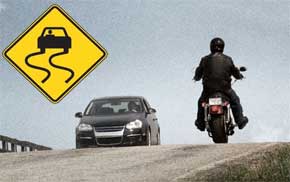
#11. What should you do when following a motorcycle on slippery roads?
Tailgating a motorcycle is a hazardous, unwise practice. Bad weather and slippery surfaces cause greater problems for motorcycles than for cars. Allow more following distance for motorcyclists when the road surface is wet and slippery.

#12. When making a left turn on a two-way street with multiple lanes, you should complete the turn in:
Always finish turning in the proper lane. Enter the left lane going your way (just to the right of the center). Do not cut the corner or turn so wide that you get into the right lane going your way. After completing the turn, you may gradually move over to the right hand lane.

#13. All the following practices are dangerous while driving. Which is also illegal?
Kansas passed a law which makes it illegal to text message when driving. This means using a wireless communications device to write, send, or read a written communication. There are some exceptions. As an example, the law does not apply to a person who receives an emergency, traffic or weather alert message.

#14. How does alcohol affect you?
Alcohol and other impairing drugs slows your ability to process information and respond to critical driving tasks. Alcohol and impairing drugs makes you drowsy and less alert to what is around you. Alcohol also affects your judgment, vision, and color distinction.

#15. This shape, a downward pointing triangle, is used for:
The yield sign will be a downward pointing triangle having a red border band and a white interior and the word yield in red inside the border band. You should recognize this sign by its shape.

#16. After passing this sign, you reach an intersection without signs or signals. You must:
T-Intersection ahead. The road ends at an intersection. You cannot go straight ahead. You must turn left or right.

#17. Signaling well ahead of a turn helps other drivers to understand your intentions and gives you the right-of-way:
Other drivers and pedestrians on the road must know what you are going to do if they are to keep out of your way. You let them know through hand signals, turn signals, headlights, brake lights and by the position of your vehicle.
Signaling dos not give you the right of way.
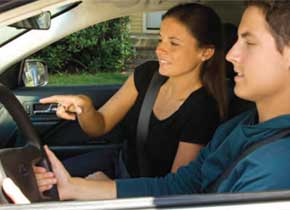
#18. To supervise a young driver with an instruction permit, you need to:
The holder of the permit may operate a passenger car at any time if accompanied by an adult who has a valid Class A, B or C license, who is at least 21 years of age and has at least 1 year of driving experience occupying the seat beside the driver.

#19. Trying to beat a truck to a highway exit is dangerous because:
Trucks take longer to stop than a car traveling at the same speed. Cutting into the open space in front of a truck removes the truck driver’s cushion of safety. Take a moment to slow down and exit behind a truck. It will only take a few extra seconds.

#20. What does this sign mean?
This is a regulatory No Bicyclists sign. It means that no bicyclists are allowed on the road. A red circle with a red slash from the upper left to the lower right means NO. You are prohibited from doing whatever is shown in the picture within the red circle.

#21. When approaching a stopped school bus that is picking up or dropping off children and traveling on your side of an undivided highway with four or more lanes, you must:
You must stop when meeting or overtaking a school bus, church bus or day care bus stopped to pick up or let off children. You must remain stopped until the stop signal is retracted and the red lights are turned off.

#22. What should you do at the first sign of rain or snow?
Reduce speed to correspond with conditions. You must also increase the distance from the car ahead of you according to the conditions of the pavement. Turn on your windshield wipers, headlights, and defroster, as needed.

#23. When entering or crossing a street from an alley within a business or residence district, you must:
The driver of a vehicle within a business or residential district emerging from an alley, driveway or building, shall stop their vehicle immediately prior to driving onto a sidewalk or onto the sidewalk area extending across any alleyway or driveway, and shall yield the right-of-way.

#24. A total stopping distance can be defined as:
Total stopping distance is the total minimum distance your vehicle has traveled until you can bring your vehicle to a complete stop. It includes perception distance, reaction distance and braking distance.

#25. On highways with several lanes traveling in the same direction, you should use the right-hand lane for:
The basic rule is to drive in the right-hand lane. The left lane is for passing or turning. Remember, when you are driving more slowly than the traffic flow on a highway that has two or more lanes in your direction, you should move to and stay in the right lane.

#26. You can park your car:
Parking is not allowed within 15 feet of a fire hydrant, or in a tunnel.
DMV Test Practice for Kansas Permit
Key numbers for the real Kansas DMV knowledge test:
| Number of Questions: | 25 |
| Correct answers needed: | 20 |
| Passing score: | 80 percent |
| Time limit: | n/a |
| Earliest retest upon failure: | next business day |
Random Practice Test – Take It Again and Again…
This is a random practice test for your Kansas instruction permit. Like the real DMV written test, each practice test has 25 questions, and the passing score is reached with 20 correct answers.
Just remember that you should aim for a full score when you practice. Read up on all your mistakes to ensure you have learned everything described in the Kansas Driving Handbook.
You can take this practice test as many times as you need. It is a random test with new questions each time you take it.
Questions and answers are drawn from a large pool of DMV questions, just like the real thing.
All answers are found in the Kansas Driving Handbook.
How to Study for the Kansas DMV Exam
1 Get the Kansas Driving Handbook.
You can download the handbook in PDF-format and save it on your phone, tablet, or computer.
It is easier to study with a hard copy of the handbook. Check with your local DMV service center to get your hands on one.
2 Study everything in the Handbook.
All information in the handbook is there for a reason, and the Kansas Department of Revenue wants to ensure you have read the handbook before issuing an instruction permit. Therefore, it draws questions for the knowledge exam from all parts of the handbook.
There is a focus on safe driving techniques and your responsibilities as a new driver. You must understand some of the fundamental driving laws in Kansas, as well as road signs, signals, and markings.

3 Use practice tests to check your knowledge.
Practice tests are a supplement to the driving handbook, and they should not be used instead of reading the guide but in combination with it.
Recheck facts in the handbook when you aren’t sure about the answers.
4 Be active.
Learning all the rules of the road doesn’t happen overnight. Give it time, and don’t attempt the actual exam too soon.
Discuss difficult questions with friends, family, teachers, or driving instructors. Pay attention to road signs, signals, markings, and traffic patterns in your daily life. They can serve as quick reminders of important facts.
5 Aim for a full score.
Be careful not to rely solely on online practice tests. Work actively to reach a better understanding of rules and safe driving. It will help you not only on the knowledge exam but also in your future driving.
When you reach a full score on more than a handful of practice tests and feel comfortable with all the answers, you are probably ready.

What You Need to Know about the Kansas DMV Test
How difficult is the test?
The Kansas Department of Revenue does not release failure rates, but the difficulty of the Kansas exam is generally rated as moderate. The knowledge exam is more challenging in a few states and more manageable in others.
Our data suggest that more than 50% of all first-time test takers pass the test.
The older a person is, the more likely they are to pass the first time.
The more time spent on preparation, the more likely a person is to pass.
Is there a time limit on the Kansas test?
There is no time limit on the Kansas DMV exam, so you have no reason to rush through the test. Re-read every question and all choices at least once before you answer. Only one of the choices is correct.
The test will not take more than 15-20 minutes – even with careful reading!
What if I fail the test?
Should you fail the test, DMV may allow you to retake it the next business day. However, all visits to a service location require an appointment, and you might not find available slots the next day.
You should also know that you must pay the testing fee every time you retest. So, it could be a good idea to spend a few more days with our practice tests.
After four failed attempts, you must wait six months before you can try again. You don’t want that.
Can I take the test from home?
Unlike some other states, Kansas does not allow you to take the knowledge test from home.
What Happens After You Have Passed the Test?
To get this far, you have already presented acceptable proof of your identity and address in Kansas. You have also passed a vision screening and paid the appropriate application fee.
If you are a minor, 14 – 15 years old, you have also submitted the parental approval form.
After passing the knowledge test, Kansas DMV will issue an instruction permit, or a farm permit if applicable.
Your new permit allows you to start practicing your driving skills.
Before you get behind the wheel, you must know a few things.
Restrictions on the Instruction Permit
Under no circumstances can you drive alone when you hold an instruction permit.
You must always drive with a supervising driver who is at least 21 years old. The supervising driver must hold a valid commercial driver’s license or a class A, B, or C driver’s license and have at least one year of driving experience.
No person other than the supervising driver can be in the front seat.
If you are under 17 years old, you cannot use any wireless communication device while driving unless you need to report illegal activity or summon medical or other emergency help. This is true even if your car has hands-free devices.
There is no night curfew or other passenger restriction while holding the instruction permit.
If you are under 17 years old, you must hold the instruction permit for a minimum of one year before DMV lets you advance to the next level in the graduated driver licensing (GDL) program, a restricted driver’s license.

Moving to Kansas
The knowledge and driving skills tests are waived if you are licensed in another state and move to Kansas. DMV will check your vision and take a new picture for a replacement license.
When you visit DMV, you must bring your out-of-state license, proof of your Social Security Number (SSN), and two documents that show your Kansas residency.
With an expired out-of-state license, DMV will always ask you to take the written knowledge test. If your license expired more than a year ago, all tests are required, including the driving test.
If you hold a driver’s license from another country, you must pass all tests and meet all requirements.
Kansas does not waive any testing requirements for licensed drivers from foreign countries.
More Information

At what age can I apply for an Instruction permit in Kansas?
You must be at least 14 years old to apply for an Instruction permit. When you apply, you must show acceptable proof of identity, submit an approval from parents if you are under 16 years, pass a vision exam, and have your picture taken. To be approved you must pass the written knowledge test or submit certificate of an approved driver education.
Waht is a farm permit?
A Kansas farm permit can be issued to teenagers between 14 years and 17 years. The permit is issued only if the teen lives on a farm consisting of 20 or more acres that is used for agricultural purposes or is employed for work on such a farm. The farm affidavit must be signed by employer (if applicable) and a parent or legal guardian.
To get a farm permit you must pass both the knowledge test and the driving skills test or complete an approved driver education.
I addition to practice driving with a supervising driver, a farm permit also lets you drive alone to/from or in connection with any farm job, employment or other farm-related work. You may also drive over the most direct and accessible route between home and school for the purpose of school attendance.
How long must I hold an Instruction Permit in Kansas?
If you are under 17 years, must hold the permit for 1 year to advance to restricted license.
How can I get the Kansas Driver Handbook?
You can download the Kansas Driver Handbook in PDF-format from www.ksrevenue.org and save it on your phone, tablet, or computer. You can also get a hard copy from a local DOV service center. During the pandemic, you should call ahead and ask for availability.
How many questions are on the Kansas DMV test?
The Kansas DMV test for an instruction permit (or farm permit) has 25 questions. You need 20 correct answers for a passing score (80%).
