
North Carolina DMV Driving Test – Study Guide – Questions & Answers
Results
You got a passing score. Do you want to try this test again?
Or try the road signs test?
Sorry, this is not a passing score. Do you want to try this test again?
Or try the road signs test?




#1. Alcohol is categorized as:
There are several things you should remember about alcohol. Alcohol is a depressant, not a stimulant. This means alcohol slows brain functions so that you cannot respond to situations, make decisions, or react quickly.
If some people feel stimulated after drinking, it is simply that their inhibitions are lowered, causing loss of caution and self-control. Alcohol often gives you false confidence. You may take greater risks because you think your driving is better than it really is.

#2. To avoid last-minute moves, you should:
Good drivers try to see 10 to 15 seconds ahead on the roadway (about one city block). By looking ahead, you might avoid last-minute moves such as sudden stops or quick lane changes.

#3. At a railroad crossing, you must give trains the right-of-way:
Trains cannot stop at railroad crossings. They must always be given the right-of-way.

#4. At a traffic circle, you must always:
II. Activate your turn signals before you enter the circle
When approaching a traffic circle, slow down. Traffic laws concerning right-of-way still apply. You must yield to pedestrians in a crosswalk and to other traffic that is already in the traffic circle.

#5. A driver can prevent airbag-related injuries by:
The force of an airbag can hurt those who are too close to it. An airbag needs about 10 inches of space to inflate. Driver and front passenger seats should be moved as far back as practical, particularly for shorter-statured people.

#6. If you have refused to take a legal chemical test of your breath or blood, the DMV must:
If an officer charges you with driving while impaired, you will be asked to take a chemical test of your breath or blood. Refusal to perform any required test will result in the immediate revocation of your driver’s license for at least 30 days and an additional, minimum 12-month revocation by the DMV. Even if you are found not guilty of DWI in court, the one-year revocation is imposed for refusing the test.

#7. In which situation are you allowed to pass a school bus?
You must not attempt to pass the school bus until the mechanical stop signal is withdrawn, the flashing red lights are turned off and the bus has started to move.

#8. You must always obey directions, signals, and instructions from:
II. Truck drivers
Under special circumstances, an officer may be directing the flow of traffic. If so, obey the officer’s hand signals instead of the normal traffic signals or signs. In connection with fires and accidents, you must also obey instructions from firefighters. Near schools, you must also obey instructions from school crossing guards.
Remember, school crossing guards may be considered traffic control officers.

#9. If you are in an intersection to make a turn when the light changes to red, you should:
A steady red circular signal means STOP. Unless there is a sign indicating NO TURN ON RED, a right turn can be made after coming to a complete stop. All vehicles turning right shall yield the right of way to other traffic and pedestrians using the intersection and to pedestrians in reasonably close proximity to the intersection and who are starting to cross in front of the traffic that is required to stop at the red light. Failure to yield to a pedestrian under these circumstances will result in a penalty of not more than $500 and not less than $100.

#10. When passing another vehicle, you should be sure to:
II. Keep a steady speed
While passing, be sure you have plenty of room and keep a steady speed. You cannot pass safely unless you can see far enough ahead to ensure that you can get back to the original lane of travel before you meet oncoming traffic.
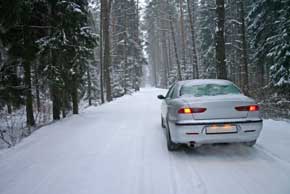
#11. When driving on packed snow, you should:
It is recommended that you reduce speed by more than half for packed snow and slow to a crawl on ice. Use chains if necessary for better traction, but do not forget that even chains and snow tires can slide on ice and packed snow.

#12. Driving at night with parking lights instead of headlights is:
Whenever it is necessary to drive with your lights on, you must use your headlights. Never drive with the parking lights on.

#13. If your vehicle breaks down on a highway, you should:
Exit the main part of the road and move the vehicle completely onto the shoulder of the road. Do not allow passengers to remain in the vehicle. Stand off the road and away from the vehicle. Never stand in front or to the rear of the vehicle. Use emergency flashers and parking lights, not headlights.

#14. What can you do to prevent carbon monoxide poisoning?
A leak in the exhaust system can allow poisonous carbon monoxide gas to enter the passenger compartment of the vehicle.
Prevention includes tight exhaust system (check it regularly) and adequate fresh air circulation.

#15. Before turning left or right on a city street without posted speed limit, you should signal during the last:
Signal at least the last 100 feet before turning or stopping. If the speed limit is 45 mph or more, signal at least the last 200 feet before turning. The faster you are driving, the farther ahead you should signal.

#16. You should expect to be in a trucker's blind spot if you:
II. Follow more than 200 feet behind the truck
Don’t lingering in the blind spots. NO-ZONES into which a car can disappear from view are up to 20 feet in front of the cab, on either side of the tractor-trailer, particularly alongside the cab, and up to 200 feet in the rear.

#17. A broken yellow center line:
Keep to the right of a yellow center line. You may cross the broken line when passing another vehicle or when the right half of the roadway is closed to traffic. But you may only cross when it is safe to do so.

#18. When a stop line is present at a stop sign, drivers must:
When a stop sign, traffic light, flashing light or other traffic-control device requires a vehicle to stop at an intersection, the driver must stop at the appropriately marked stop line. If there is no stop line or marked crosswalk, the driver must stop before entering the intersection where they has a view of the intersecting street.

#19. Which is true about bicyclists?
II. They must obey the same traffic laws as other drivers
It is especially important for bicyclists to go with the flow of traffic, not against the flow.
Because bicycles are vehicles, bicyclists must obey the same traffic laws as other drivers. Like drivers, bicyclists must ride on the right side of the road, stop for stop signs and red lights, and give signals.

#20. Where is it illegal to park a vehicle?
II. On the left side on a one-way street
Never park within 15 feet of a fire hydrant or entrance to a fire station.

#21. To stay alert on a long trip, you should:
II. Avoid looking at different objects
Stop regularly when driving long distances. Get out of the car at least every 2 hours to stretch and walk briskly.
If you are tired and in danger of falling asleep, you cannot predict when a mini sleep may occur. A driver cannot react to road dangers when tired.

#22. What parts of a road might hold frost and ice while the rest is dry?
Shaded spots on the highway will hold frost and ice while other portions of the pavement are dry. The same is true of bridges, which will hold frost and ice while the rest of the road may be safe.

#23. This flagger signal means:
To let traffic proceed, the flagger is holding the flag down next to the body. The free hand is swinging in an upward arc from below the horizontal arm toward the flagger’s head.
Remember, motorists are responsible for knowing how to read and react to these directions.
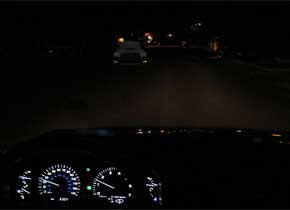
#24. What can you do to alert another driver who does not dim their headlights?
When an approaching vehicle does not dim its headlights, you can remind the driver by blinking your high beams once. If the driver still does not dim the lights, make sure you keep your lights on low beam. Stay on the right side of the road. Do not look directly at oncoming headlights. Instead, look down the right edge of your lane.

#25. If you are convicted of following another vehicle too closely, it will result in the following points on your driving record:
Following too closely will result in four points on your driving record.
Points while operating a commercial motor vehicle are higher.
Make sure you study the right table!
The North Carolina DMV Written Road Rules Test
Key numbers for your NC DMV Written Test, part II:
| Test questions: | 25 |
| Passing score: | 80% |
| Correct answers: | 20 |
| Time limit: | No |
| Earliest retest if you fail: | 7 days |
North Carolina DMV Two-Part Examination
To be eligible for your first North Carolina Learner’s Permit or Driver’s License, you must pass a two-part driver’s knowledge test.
The first part is a 12-question road signs identification test. You must identify at least 9 signs based on color, shapes, symbols, or messages.
The second part is a multiple-choice test with questions about North Carolina traffic laws, common road rules, and defensive driving strategies.
To pass the examination, you must reach a passing score of 80% on each test. Scores cannot be combined.
Part I: Road Signs Test
In this part, you will be asked to identify 12 road signs (or just shapes and colors of road signs). Signs on this test are described in North Carolina Driver Handbook. Focus on the two road sign charts in the manual, but don’t forget to read the part about the general use of shapes and colors.
You can practice for your North Carolina road signs test here .
Part II: Road Rules Test
The main part of your driver’s examination has 25 multiple-choice questions about all road rules that are described in the handbook, including specific NC traffic laws.
To pass this part of your exam, you must have a copy of the Driver Handbook. Get the most recent update to make sure you have the latest additions and changes to North Carolina laws. We recommend that you get a hard copy from NC DMV, but if you are comfortable with reading on a screen, you can also download a free handbook version online .
You cannot miss more than 5 questions on this part of your exam.
Is the North Carolina Written Test Difficult?
The road sign part of the exam is considered to be easy, while the second part is a bit harder. Unofficial numbers suggest that one-third of applicants fail the exam the first time.

What Happens if I Fail the North Carolina Written Test?
You must wait at least seven days before you can retest. In most cases, people pass the exam on their second attempt. Just make sure you feel comfortable with the questions you got the first time. By learning from your mistakes, you improve your chances of passing.
Tests are random, so you will not get the same questions the next time.
There is no fee for taking the test again.
Is There a Time Limit?
There is no time limit, and you are given at least 30 minutes to finish the two tests. In our experience, most test takers finish within 15-20 minutes.
If you have studied the handbook and taken enough practice tests, most questions should be familiar to you, and answering them will be easy. Your main key to success is to carefully read both questions, statements, and/or choices before you pick your answer.
Young students who fail their exams often blame themselves for not being more careful when answering the questions.
Is the Test Available in Other Languages?
The North Carolina DMV written test is available in nine different languages.
| Arabic |
| Chinese |
| English |
| German |
| Japanese |
| Korean |
| Russian |
| Spanish |
| Vietnamese |
If you don’t speak any of these languages, you may be offered an oral test with a translator. Always contact your DMV office ahead of your test to get more information.
How Can the Practice Test Help Me Pass the Written Exam?
Most experts agree that taking practice tests before an exam really helps. The benefits are:
Getting familiar with test format
Being active during the study phase
Getting facts presented with different wordings
You should, however, use practice tests wisely. A common mistake is to try to use them as a cheat sheet and just memorize answers.
Understanding why some answer alternatives are wrong can be just as important as understanding the correct answers.
How Often Should I Take this Practice Test?
There is no limit on how many times you can take this practice test. The question pool has more than 500 questions, many addressing the same subjects but with different approaches.
With many random questions, you can feel comfortable that you will cover all the important facts that you must know for your examination.
If you can achieve a full score on a handful of practice tests, you are probably ready for the real driver’s examination.
Don’t Forget to Also Study the Road Signs Test

