
Mississippi DMV Test Practice – Permit Test Questions & Answers
Results
Good job, this a passing score. Do you want to try again?
Sorry, this is not a passing score. Do you want to try again?



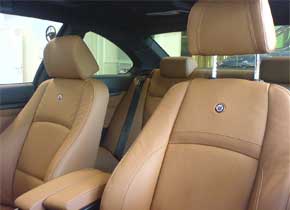
#1. Before you start to drive, you should adjust your seat so that:
Adjust your seat to a comfortable position so that you can reach the wheel and pedals easily and have good vision. Fasten your seat belt, and then adjust the rear-view mirror so that you can see the roadway behind. If you have a left outside mirror, remember to adjust that too.

#2. When turning left from a two-way street onto a one-way street, you should complete the turn in:
When making a left turn into a one-way street, get into the left lane well ahead of the turn. Turn sharply into the left lane.
A good rule to remember when traveling on a one-way street is to always turn from the lane nearest the curb. (However, pavement markings or signage may permit turning from additional lanes.)

#3. What does this sign mean?
Yield ahead. This sign warns of a yield sign ahead. Slow down and be prepared to stop at yield sign.

#4. When parking parallel to a curb on a two-way roadway, you must park within:
If you have parked properly, the wheels should not be more than 12 inches from the curb.

#5. You approach a stopped school bus on your side of a divided highway. The bus is displaying alternating flashing red lights. In this situation, you must:
You must stop for a school bus, regardless of your direction, whenever the bus is stopped and receiving or discharging children. You must not proceed until the children have crossed the street or highway and the school bus has resumed motion or the flashing red lights are no longer actuated and the hand-operated stop sign is retracted.
You are not required to stop when the highway that has four lanes or more, and the school bus is on a different roadway.

#6. When you change lanes, you should:
Look over your shoulder in the direction you want to move. Be sure no one is near the left or right rear corners of your vehicle. These areas are blind spots. To see the blind spots, you have to turn your head and look.

#7. What is most important when you adjust to a safe speed?
Posted speed limits do not tell you at what speed to drive. They only tell you what the maximum legal speed is under ideal conditions. By law, you have to go slower if conditions make the posted speed limit unsafe. Your speed should depend on things like traffic, road condition, weather, visibility, and the presence of bicyclists or pedestrians.

#8. When an emergency vehicle using flashing red lights approaches you from behind, you must
Any emergency vehicle flashing red or blue lights or signaling with a bell or siren must be given the right-of-way on any street in any traffic situation. Pull over to the extreme right-hand side of the road until the emergency vehicle has passed.
If you are at an intersection, proceed through, and then pull over to the extreme right.

#9. What should you do when approaching a railroad crossing and seeing a vehicle with this sign ahead?
If outside a business or residence district, the following vehicles must always stop at a railroad crossing:
- A vehicle carrying passengers for hire.
- A school bus carrying any school child.
- A vehicle carrying explosive substances of flammable liquids.
Remember to watch out for vehicles which must stop whether or not a train is coming.

#10. To avoid glare from headlights of an approaching car at night:
If you meet a vehicle at night with bright or blinding headlights, the safest thing to do is to dim your lights and keep your eyes on the right side of the road.
Never attempt to compensate by wearing darkened glasses. At night, or on dark days, the use of such glasses will only reduce your vision further.

#11. If you have pulled out to pass another vehicle on the left side of the road and an oncoming vehicle is approaching faster than expected, you should:
When you decide to pass another vehicle on the left, be sure that the lane ahead is clear before you move. If it appears that you will not have time to complete the pass before meeting oncoming traffic, slow down and return to the lane behind the vehicle you were passing.

#12. How should you position your car if you stop behind a truck on an uphill grade?
If you are stopped behind a large vehicle on an upgrade, leave additional space in case the vehicle drifts backwards slightly when it starts to move. Remember to keep to the left in your lane so the driver can see that you are stopped behind the vehicle.

#13. A flashing red traffic signal at an intersection has the same meaning as:
A flashing red light has the same meaning as a stop sign. It means you must STOP completely and proceed with caution, following the rules for yielding right-of-way at intersections.

#14. Noise-making devices, such as bells, sirens, and whistles on your vehicle are:
It is against the law for you to have any siren or exhaust or spark whistle on your vehicle. Noise making devices are illegal.

#15. What does this sign tell you?
The One Way sign is used in intersections to indicate streets or roadways upon which traffic is allowed to travel in one direction only. It means you may only enter the street in the direction of the arrow.
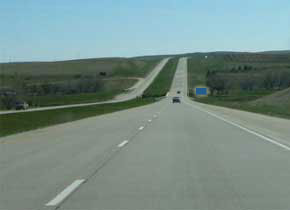
#16. You are driving on a rural highway. You see a blue road sign far ahead. The sign will most likely:
Motorist services signs are white on blue. They direct you to services, such as rest areas, tourist sites, hospitals, hotels, gas stations, eating places, campgrounds or picnic areas. Blue is also used to identify parking spaces for disabled drivers.

#17. What does this sign mean?
Sharp Turn. This sign warns of a sharp turn in the direction of the arrow. Slow down before the turn.

#18. By driving in this state, you have agreed to be tested for alcohol or drugs. This law is known as the:
When you operate a motor vehicle in the state of Mississippi, you are giving your implied consent to testing for the presence of intoxicating substances in your body. If a law enforcement officer has good reason to suspect that you are operating your vehicle under the influence of an intoxicating substance, he can request you to take a breath or chemical test.
This is known as the implied consent law.

#19. If you have a tire blowout while driving, you should:
If you develop a flat tire or have a blowout, do not apply your brakes suddenly. Hold the steering wheel firmly. Take your foot off the accelerator, and then apply the brakes slowly and cautiously. If you have plenty of stopping distance, let the vehicle stop by itself. Remember, keep the vehicle going straight until you have full control.

#20. When is it acceptable to drive with your lights on high beam?
Use upper beam only when driving in the open country without other cars near. Even with the upper beam, speed should be lower than by day.
If you meet a vehicle at night with bright or blinding headlights, the safest thing to do is to dim your lights and keep your eyes on the right side of the road.

#21. When entering or crossing a street from an alley within a business or residence district, you must:
When leaving an alley, driveway, or building within a business or residence district you must stop immediately prior to driving onto a sidewalk or into the sidewalk area.

#22. Children four years to under seven years must normally be properly secured in:
Children at least four (4) years, but less than seven (7) years and measures less than four (4) feet nine (9) inches in height or weighs less than sixty-five (65) pounds must be secured in a belt-positioning booster seat system.

#23. What does this sign mean?
School zone: This sign marks a school zone. Speed limit is 15 mph when passing a school during school recess or while children are going to or leaving school during opening or closing hours.

#24. Which of the following is unsafe when driving on a multi-lane highway?
Use the proper lane at all times. The left lane is considered the fast lane and is to be used by through traffic. The right lane is for slower traffic, vehicles traveling only short distances, and vehicles preparing to exit.
This question asked what is NOT a safe driving practice.

#25. A broken white line separating traffic lanes means:
A broken white line means travel in the same direction is permitted on both sides of the line. A vehicle may cross the line to change lanes when it is safe to do so.
The Mississippi Written Knowledge Test
Key numbers for your official knowledge exam in Mississippi:
| Test questions: | 30 |
| Passing score: | 80% |
| Correct answers: | 24 |
| Time limit: | No |
| Earliest retest if you fail: | 1 day (first three) |

What is Mississippi DMV Test Practice?
This Mississippi DMV test practice is a study guide to help you pass the written knowledge test for a learner’s permit or driver’s license. It is based on exam questions and answers and the information in the Mississippi Driver’s Manual published by Driver Services Bureau.
The practice test has 25 random questions drawn from a larger bank of questions, meaning each set will look slightly different.
You can take the test as often as you want until you feel ready for the actual Mississippi DMV (DPS) exam. After each question, you will get instant feedback that tells you if you picked the correct answer. When your answer is wrong, there is a short explanation to help you understand the right answer.
Your score is revealed at the end of the test. Try to reach 100% before you are fully satisfied.
Is it the Same Questions on the Real Test?
Licenseroute.com is not affiliated with Mississippi Driver Services Bureau. There is no access to the actual exam questions.
The practice test, however, covers all the essential subjects that may show up on your test. But both tests are random, so there is no way of telling which questions you will get on your written exam.

Do I Need the Driver’s Manual?
The Driver’s Manual in Mississippi, even the online version, comes with a fee. While some don’t feel that the manual is worth the money, it is your best resource when studying for the test.
Practice tests should only be used as a supplement to the manual.
Remember, everything on your knowledge exam is from this manual.
How Many Questions are on the Mississippi Written Test?
The official written test in Mississippi has 30 questions, of which you must correctly answer 24, with a passing score of 80%. You can miss no more than six questions.
What Happens if I Fail the Test?
If you fail the test, you can retake it the next day at the examiner’s discretion.
Should you stumble on the last question, you may want to return as early as possible. Just remember to read everything more carefully this time.
If you fail early on in the test, you may want to wait more than one day, dig deeper into the manual, and take many more practice tests to prepare better.
After three failures, you must wait 30 days before retaking it.
Is the MS Written Test timed?
There is no time limit on the test, and you have plenty of time to read everything more than once. Expect the test to take about 15 minutes.
Is the MS Written Test hard?
The Mississippi permit test’s failure rate is among the country’s highest. Surveys also indicate that young test takers in Mississippi are less prepared than their peers in other states.
The test and the Mississippi Driver’s Manual have also been criticized for not being revised to modern standards.

Can I Take the Mississippi DMV Test Online?
No, the Mississippi Driver Services Bureau does not offer online testing from the comfort of your home.
You must take the test at a service office or a school as part of your driver’s education.
At What Age Can I Get a Learner’s Permit in Mississippi?
If you are enrolled in a driver’s education, you can apply for a permit when you are 14 years old, known as the 14-year-old learner’s permit. It is valid for driving practice as part of your driver’s education. You can drive only in a school vehicle and only when accompanied by a driver education instructor.
If you are at least 15 years, you can apply for a regular learner’s permit, often referred to as the 15-to-16-year-old permit. You must bring a completed application signed by parents or guardians, a birth certificate, a Social Security card, and proof of school enrollment to a service office. After passing the written driver’s knowledge test and a vision screening, the Bureau will issue a learner’s permit.
What are the Restrictions on my MS Learner’s Permit?
With a learner’s permit, you cannot drive on your own, and the permit can only be used for driving with a licensed driver who is at least 21 years old and is sitting in the front seat beside you.
You must always carry the permit with you when you drive.
If you are under 17 years, you must hold the permit for at least one year.
What is an Intermediate Driver’s License?
The second phase in the Mississippi Graduated Driver Licensing program is the intermediate license, which requires passing a road skills test.
If you are at least 16 years and have held a learner’s permit for at least one year, you may be ready for the practical driving skills test.
You must bring all documents again and pass the vision screening before the skills test. The signatures of your parents or guardians are also required again. If all documents are approved, and you pass the skills test, the Bureau will issue an intermediate license. This license allows you to practice driving on your own.
You can, however, not drive on your own between 10 p.m. and 6 a.m. Sunday-Thursday nights or 11:30 p.m. – 6 a.m. Friday and Saturday nights, except for going to and from work/school.
You and all passengers must wear seat belts/child restraints while driving.
You must hold the intermediate license for at least six months and be at least 16 1/2 years before you can upgrade to a regular license.
At What Age Can I get a Regular MS Driver’s License?
To get a regular MS license, the Bureau must approve all your documents, and you must also pass all required examinations and meet the physical requirements.
In addition, you must:
- Be at least 16 years six months and have held an intermediate license for at least six months, or
- Be at least 17 years or older, regardless of previous permits or licenses held, or
- Have held an out-of-state driver’s license for at least six months.
In general, you must also be free of certain convictions.
Must I Take the Knowledge Test a Second Time?
The result of your written knowledge test is valid for two years. If you pass the final driving exam for a regular license within two years, the Bureau will not ask for a second test. But if you wait longer than two years, you must start over and retake the test.
