
Minnesota DVS Knowledge Testing – 500 Questions – No Cost

Results
Great! This is a passing score. Do you want to try again?
This is not a passing score. Do you want to try again?




#1. At a Stop sign, the law prohibits parking:
Parking is not allowed within 30 feet of any flashing light, stop sign, or traffic control signal located at the side of a public road.

#2. Failure to stop for a school bus with its stop arm extended and its red lights flashing carries a fine of:
The penalty for this violation is a fine of not less than $300, and suspension of your driving privileges. When you apply for a driver’s license, you must certify, by signing the application, that you understand that you must stop for a school bus and are aware of the penalties for violating this law.

#3. If you run off the pavement, you should:
If your wheels drift onto the shoulder of the road, do not try to swerve back onto the pavement. Stay on the shoulder and slowly release the gas pedal.
#4. What is the basic speed law?
Minnesota’s basic speed law requires you to drive at a speed no faster than is reasonable under existing conditions. These include weather, traffic, and road conditions. Driving faster than the posted speed limit is illegal.

#5. Two vehicles approach an uncontrolled T-intersection. One is on the through road, the other on the road that ends. Which vehicle should have the right-of-way?
When vehicles approach an uncontrolled T-intersection, the driver of the vehicle that is turning must yield to all cross traffic.

#6. Why should you be prepared to stop when approaching a railroad crossing and there is a truck with a hazardous load ahead?
School buses and commercial buses are required to stop at all railroad crossings whether carrying passengers or not. While stopped, the driver must open the driver’s window and service door to look and listen in both directions along the track for any approaching train. Trucks carrying hazardous materials are also required to stop at all grade crossings. They must stop whether or not a train is present. Do not pass these vehicles.
Remember, it is illegal to pass any vehicle within 100 feet of a railroad crossing.

#7. If your gas pedal sticks:
If your gas pedal sticks, you may be able to free it by hooking your toe under the pedal and raising it. If this does not work, apply the brakes, and shift into neutral, this will disengage the engine. Next, choose a safe path and steer to the shoulder of the road.

#8. When approaching this sign, traffic in the right lane:
Lane Use.
Traffic in the right lane may proceed straight ahead or turn left. Traffic in the left lane must turn left.
You must obey the sign in your lane. When the word ONLY is used, you must go in the direction the arrow points – there is no option.

#9. Any time when it is raining, snowing, sleeting, or hailing, you must:
Headlights must be used:
- at any time from sunset to sunrise
- at any time when it is raining, snowing, sleeting, or hailing
- at any other time when visibility is impaired by weather, smoke, fog or other conditions or there is not sufficient light for you to clearly see the road ahead for a distance of at least 500 feet.

#10. When you see emergency lights behind you, you should:
When you see emergency lights behind you, stay calm, activate your turn signal, and pull off or to the right side of the roadway as soon and safely as possible.

#11. Which is true about braking and stopping?
Be alert so that you know when you will have to stop well ahead of time. Stopping suddenly is dangerous and usually points to a driver who was not paying attention. When you brake quickly, you could skid and lose control of your vehicle. You also make it harder for drivers behind you to stop without hitting you.

#12. When you see a sign with this shape, color, and symbol, you must:
If this sign is facing you, do not enter. You will see this sign at openings to roadways that you should not enter, such as exit ramps where you would be going in the wrong direction, in crossovers on divided roadways and on one-way streets.
Remember, the sign is square, it is not circular!

#13. What does this sign mean?
Crossroad.
A four-way intersection is ahead. Prepare to yield.

#14. You may change lanes when it is safe, and the line dividing the two lanes is:
A line composed of white dashes indicates that drivers can change lanes in areas where this type of marking is present. Once you have signaled, and if it is safe to do so, you may cross this line.

#15. Which lane should you use for a left turn?
Lane-use control signals are special signals posted by the side of the road or overhead. A flashing yellow X means the lane is only for turning.

#16. Which is true about carbon monoxide?
Carbon monoxide is a deadly, odorless, and colorless gas produced by engines.

#17. Orange road signs indicate:
Orange is used for construction and maintenance warning. The signs are usually diamond shaped. They notify drivers of unusual or potentially dangerous conditions near work areas.

#18. What is the hand signal for a right turn?
Right turn – left arm extended, with elbow bent upward, at about a 90-degree angle.

#19. Where is a U-turn illegal?
U-turns are illegal on interstate freeways and on a one-way street (you will be driving against traffic). U-turns are also illegal near the tops of hills and on curves where other drivers cannot see you from 1,000 feet away.
The law does not prohibit U-turns in front of police stations, unless a No U-turn sign is posted. Make sure the U-turn can be made safely and without disrupting other traffic.

#20. Which is true about commercial vehicles like large trucks?
Large vehicles generally:
- Accelerate more slowly.
- Need more room to maneuver safely.
- Require greater stopping distances.
- Have larger blind spots.
- Make wide right turns.

#21. What does this sign mean?
Merging Traffic or Merge sign. Vehicles merge onto the roadway on which you are traveling. Be prepared to allow vehicles to enter traffic near you.

#22. If your tires begin to hydroplane, you should:
If your tires begin to hydroplane, take your foot off the gas pedal. When your tires hydroplane, they lose all contact with the road. If this occurs, you will be unable to brake, accelerate, or change direction.

#23. When approaching an intersection where the traffic light changes from green to yellow, you should:
A steady yellow light means Caution. The signal is about to turn red.
Do not enter the intersection if you can stop safely before doing so.
If you cannot stop safely, proceed through the intersection with caution.

#24. What do the light gray areas in the picture mark?
Blind spots are areas around your vehicle where your view is obstructed. You cannot see pedestrians or other vehicles in your rearview or side mirrors when they are in these locations.
Before making lane changes or turns, quickly turn your head to look for hidden pedestrians or vehicles. Avoid driving in other drivers’ blind spots.

#25. When you plan to exit a freeway, you should:
Plan ahead. It is helpful to know, before you begin driving, where you need to exit the freeway. Watch for signs that provide information about upcoming exits.

#26. If you plead not guilty and are convicted of a Driving While Impaired (DWI) violation a first time, your license will be:
If you are found guilty of a DWI violation and it is your first conviction, your license will be revoked for a minimum of 90 days (30 days if individual pleads guilty to DWI).

#27. True or false? Anyone driving a vehicle with enabled airbags is not required to use seat belts.
An airbag is a supplemental restraint system. Airbags are intended to work with seat belts to prevent injuries. They do not replace seat belts.
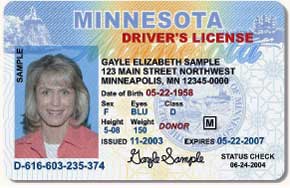
#28. A driver's license is:
A driver’s license is a privilege and comes with responsibilities. Your license may be withdrawn by suspension, revocation, or cancellation.

#29. This sign means:
A yield sign is a downward pointing triangle. It is red and white with red letters. You will see no other signs of this shape on the highway.
Slow down and give vehicles crossing your path the right-of-way. If the way is clear, you may move forward slowly without stopping. Yield signs are usually placed where auxiliary roads lead into major roads.

#30. Which of the following is a likely effect of drinking alcohol?
Alcohol is a depressant that slows body functions and impairs motor skills. Drivers who consume alcohol misjudge their degree of impairment. They may drive too fast, misjudge stopping distance, fail to wear a seat belt, and forget to drive defensively.

#31. When driving beside a motorcycle:
Crowding a motorcyclist is illegal and dangerous. Never attempt to drive alongside a motorcycle in the same lane.

#32. What should you use a center lane with a solid yellow line and a broken yellow line on both sides for?
A center lane between lanes of traffic traveling in opposite directions may be designated for left turns only. This type of lane is marked by parallel solid and dashed yellow lines. These lines are sometimes accompanied with white arrows on the pavement. Vehicles traveling in either direction can use these lanes to make left turns onto another roadway or a driveway.
This lane is not a regular traffic lane or a passing lane. If a two-way left turn lane has been provided, do not make a left turn from any other lane.

#33. You have a green light and vehicles are blocking your way in the intersection. What should you do?
A green light means you may begin to cross the intersection as soon as it is clear. Yield to any vehicles or pedestrians in the intersection. You must not enter an intersection until you can immediately, continuously, and completely move through the intersection without impeding or blocking the movement of cross traffic.

#34. When you approach a highway work zone, you should:
Watch for workers and equipment and adjust your lane position to keep a safe distance. Be prepared to slow down or stop.

#35. The legal drinking age for alcohol is:
The legal age to buy and drink alcohol in Minnesota is 21. It is illegal for a person under age 21 to operate a motor vehicle with any detectable amount of alcohol in their system.
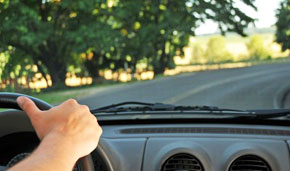
#36. On two-lane roads with traffic moving in both directions, it is illegal to pass on the left side before a curve or hill if you cannot clearly see the road ahead for at least:
Remember, it is illegal to pass on the left side when approaching a curve or hill where you cannot clearly see the road ahead for at least 700 feet.

#37. If you turn on high-beam headlights when driving in thick fog:
Use the low beams in fog, or when it is snowing or raining. Light from high beams will reflect back, causing glare and making it more difficult to see ahead.

#38. When you approach a roundabout, you must:
Slow down as you approach the roundabout. Yield to pedestrians and bicyclists crossing the roadway.

#39. Driving under the influence of medication that impairs your ability to drive safely is:
Drug-impaired driving is as dangerous as alcohol-impaired driving. Minnesota law prohibits driving while impaired by controlled or hazardous substances. These substances include illegal drugs and prescription drugs, as well as household products.

#40. What does this sign mean?
Divided Highway Ends.
The divided road ends ahead. Two-way traffic will no longer be divided by a center island. You will be on an undivided roadway with two-way traffic. Keep to the right.
If you got this question wrong, look at the divider or median on the sign. If it is located at the bottom, it means that you are leaving a divided highway. When the divider is located at the top of the sign, it means that you are approaching a divided highway.
Minnesota Driver’s Knowledge Exam
Quick facts about your written driver’s license exam in Minnesota:
| Number of Questions: | 40 |
| Correct answers needed: | 32 |
| Passing score: | 80 percent |
| Time limit: | 30 minutes |
| Earliest retest upon failure: | 1 day |
500+ Minnesota Test Questions
This Minnesota practice test has 40 questions to help you pass the written knowledge test for a permit or full driver’s license. It pulls random questions from a pool of more than 500 questions, which makes each set of questions unique and gives you plenty of practice.
After answering a question, you will get instant feedback that tells you whether your answer is correct or not. When you miss a question, there is also a short description to help you understand the right answer. At the end of the test, you will see your final score, which can help you determine whether you are ready for the exam.

Study the Driver’s Manual
Always start by reading the Minnesota Driver’s Manual. You must understand the manual’s contents well to pass your driver examination and become a safe driver.
You can get a copy of the manual from any Driver and Vehicle Services (DVS) office, most driving schools, or online .
Unless you are already familiar with most traffic laws, you should read the manual several times over at least 1 – 2 weeks. The more time you spend with the manual, the easier the examination will be.
The purpose of the DVS knowledge testing is to make sure you have read the manual. For this reason, every question on the exam is drawn directly from the manual’s contents. Language and wordings are often the same.
The Use of Practice Tests
You can pass your Minnesota knowledge exam even if you don’t take practice tests, but studies show that you are much more likely to pass after using practice tests.
Practice testing, or retrieval practice, is one of the most powerful learning techniques.
By testing yourself, you will better understand what you already know and what you need to study some more. Recognizing questions and pulling the correct answer out of your memory also means you can remember it more easily later on.
It would be best to take as many practice tests as possible to feel comfortable with all questions and answers. Since knowledge tests are random, you don’t know which questions will appear on your exam. It would help if you covered all areas in the manual.
What You Should Know about the Exam
By law, the test must always check your knowledge of the following:
-
Minnesota traffic laws
The effects of alcohol and drugs on a driver’s ability to operate a motor vehicle safely and legally
The legal penalties and financial consequences resulting from violations of laws prohibiting the operation of a motor vehicle while under the influence of alcohol or drugs
Railroad grade crossing safety
Slow-moving vehicle safety
Laws relating to pupil transportation safety, including the significance of school bus lights, signals, stop arm, and passing a school bus
Traffic laws related to bicycles
The circumstances and dangers of carbon monoxide poisoning
The passing score in Minnesota is 80 percent. You must correctly answer 32 out of 40 questions.
You must complete your test within 30 minutes. The allotted time is usually more than enough, and most test takers finish the test in less than 20 minutes. So, don’t rush through the test just because you think you are running out of time. It is better to take your time and read everything carefully; that way, you will make fewer unnecessary mistakes.
If you fail the exam, you can often retake it the next day.
If you take the test at a DVS exam station, you must schedule the test in advance. Exam stations no longer accept walk-ins for the DVS knowledge testing.
The test is available in English, American Sign Language, Hmong, Karen, Russian, Somali, Spanish, and Vietnamese at DVS exam stations. Audio assistance is also available.
Online Testing from Home
Since 2020, Minnesota has offered an online test you can take from home.
For the online test at home, you need a proctor. A proctor is a person who monitors students during a test or exam. A proctor must be 21 or older and hold a valid Minnesota driver’s license.
After DVS approves your home test request, you have 48 hours to complete the online knowledge test.
The home test is only available in English and Spanish.
You can register for a second chance if you fail the home test. But after a second failure, you must take the knowledge test at a DVS exam station or an approved third-party tester. You will also be charged an additional fee to take a third test and any subsequent tests.
Is the Minnesota Permit Test Hard?
The failure rate on the permit test in Minnesota is almost 50 percent. This means that we grade the difficulty level as “hard.”
Pay special attention to Minnesota’s DWI laws, including penalties and financial consequences, since these facts can be hard to remember.

