
New Jersey MVC Written Knowledge Test for 2026
Results
This is not a passing score. Do you want to try again?




#1. Why is it a good idea to always be alert to motorcycles?
Motorcycles can be hard to see in traffic. Motorists must be more careful about pedestrians and less-visible vehicles, such as bicycles, mopeds, and motorcycles. Check blind spots twice before changing lanes or making turns. Always watch for motorcycles at intersections and when turning left. A motorist’s failure to detect and recognize motorcycles in traffic is the most common cause of motorcycle crashes.

#2. You see this road sign. What should you expect ahead?
Divided highway ahead. The highway ahead is divided into two one-way roadways.
Divided highways have a center strip that separates traffic going in opposite directions. The first sign is posted before a divided highway begins.

#3. Road signs that give directions and information are usually:
Horizontal rectangles are generally used to give directions or information.
When vertical, signs are generally used to give instructions or tell you the law.

#4. When driving at night, you should:
To drive safely at night, slow down and drive within the range of the vehicle’s headlights. Allow for more safety margins than you would during daylight. Keep the interior light off, and adjust your instrument lights as low as you can to still be able to read the gauges.

#5. With an examination permit, you may drive alone:
With a permit you cannot drive alone.
Permit holder must be accompanied in the front seat by an adult supervising driver who is at least 21 years of age and who possesses a valid New Jersey driver’s license and has a minimum of three years driving experience.

#6. If you need to use arm signals, how would you signal a left turn?
Left turn – left arm extended horizontally out of open window.

#7. Infant car seats should be installed where?
Children under age two who weigh less than 30 pounds must ride in a federally approved rear facing child passenger restraint system that is equipped with a five-point harness. They should always be placed in the back seat. Children cannot be secured in a rear facing child passenger restraint system in a front seat of any motor vehicle that is equipped with a passenger-side airbag that is not disabled or turned off.

#8. You may continue carefully against a yellow light if:
A yellow traffic signal light means caution. The red signal is about to appear.
When a yellow light follows a green light, a motorist must stop before entering the intersection, unless yellow appears when the vehicle is too close to stop safely. If the light changes while a driver is already in the intersection, he/she should go through with caution.
Never try to beat a traffic light change. Most accidents at traffic signals happen in the first few seconds after the light has changed.

#9. What can help you develop good judgment for proper following distances?
Since most people have trouble judging distances, the three-seconds-plus rule to determine safe distance may be easier to use. Try the rule while driving. It can help you develop good judgment for proper following distances.

#10. When are you allowed to park your vehicle on a crosswalk?
Never stop or park your vehicle on a crosswalk.

#11. Normal dashed white lines is used as pavement marking between lanes:
White dashed lines separate traffic lanes on multi-lane highways.
Dashed lines are permissive in character.

#12. The first time you refuse to take a breath test to measure how much alcohol is in your system:
The current penalty for refusal is the loss of driving privileges for between seven months and one year, to run concurrently or consecutively, based upon a judge’s order. Motorists who refuse to take a breath test in New Jersey are also subject to a violation surcharge of $1,000 per year for three years (N.J.S.A. 17:29A-35). Failure to pay this surcharge will result in an indefinite suspension of driving privileges until the fee is paid.
#13. Why can it be dangerous to start your vehicle or warm up the engine in a closed garage:?
Avoid idling a vehicle in a garage. Certain conditions can cause dangerous levels of carbon monoxide to accumulate in or around a vehicle

#14. This sign tells you:
This is a regulatory Speed Limit sign. It shows the minimum speed you are allowed to travel.

#15. What does this sign tell you?
Winding Road. There are several curves ahead. Slow down and drive carefully.

#16. A school bus with flashing red lights has stopped on the other side of a four-lane roadway with a center turning lane. What should you do?
State law requires you to stop at least 25 feet away if traveling on a two-lane road or on a multi-lane highway where lanes are only separated by lines or on a privately maintained road. When traveling on a dual-lane highway, a motorist should slow to 10 mph if on the other side of a safety island or raised median.

#17. What is the meaning of this sign?
Stop sign ahead. When you come to this sign, you should slow down and be ready to stop at the stop sign ahead.
#18. It can be dangerous to leave a motor running in a garage because of:
Avoid idling a vehicle in a garage. Certain conditions can cause dangerous levels of carbon monoxide to accumulate in or around a vehicle

#19. After a crash, your car plunges into deep water. You cannot open a window or door. What should you do?
Wait until the car fills with water. When the pressure inside and outside the vehicle is equal, it is easier to open a door.

#20. What should you do if you approach a fire scene and there is an unprotected fire hose on the road?
Never drive over a fire hose unless directed to do so by a fire, emergency rescue or police official.

#21. Vehicle stopping distances depend on:
Stopping distance depends on:
- Motorist perception and reaction time
- Weather and visibility conditions
- Vehicle weight
- Brake conditions
- Condition and type of tires
- Roadway conditions
- Speed
Posted speed limit does not affect your stopping distance, only your actual speed does.

#22. You approach an intersection. Where should you stop if there is a stop sign but no stop line or crosswalk?
When a stop sign, traffic light, flashing light or other traffic-control device requires a vehicle to stop at an intersection, the driver must stop at the appropriately marked stop line. If there is no stop line or marked crosswalk, the driver must stop before entering the intersection where he/she has a view of the intersecting street.

#23. When you drive through a construction zone, you should:
When you drive through a construction zone, you should watch for workers and moving construction machinery on the highway and be prepared to slow down or stop.
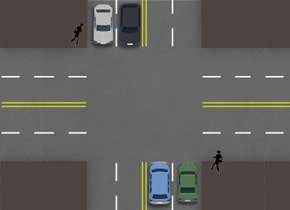
#24. When turning right, you must:
When turning right, you must be in the extreme right-hand travel lane or a lane designated for right turns. Signal your turn at least 100 feet ahead. Yield to pedestrians and bicyclists.

#25. When can you legally drive faster than the maximum speed limit?
It is always unlawful to drive at a speed exceeding a posted speed limit.

#26. You may only overtake another vehicle on the right on a two-lane, two-way roadway if:
You may pass on the right (but not on the shoulder), when you have enough room on a two-lane roadway, and when the vehicle you are passing is making or is about to make a left turn.

#27. When driving in fog, you should:
Always slow down when driving in fog. Headlights must be used and should be kept on low beam. Fog lights should be turned on if the vehicle has them. It is important to keep a safe distance between vehicles, do not tailgate!
New Jersey MVC Written Test
Quick facts about your MVC driver’s license and learner’s permit test in New Jersey:
| Number of Questions: | 50 |
| Correct answers needed: | 40 |
| Passing score: | 80 percent |
| Time limit: | None |
| Earliest retest upon failure: | – |
500+ New Jersey MVC Written Test Questions
With these practice tests, you can pass your written NJ knowledge exam on your first try. Appointments for written tests are in high demand, and waiting times can be long at some locations, so preparing well for your written test is a good idea.
This practice test is a random multiple-choice test with 25 questions. You can take it as many times as you need to prepare. The database contains over 500 questions to help you cover all essential facts in the New Jersey Driver Manual.
The exam has 50 questions, and the passing score is 80%, meaning you must correctly answer at least 40 questions. You should aim for a higher score on these practice tests to pass the real thing.

What is on the New Jersey Written Knowledge Test?
The primary purpose of the NJ written test is to check that you have read and understood the information in the Driver Manual.
It isn’t easy to pass the examination without reading the manual, so we recommend starting by getting a copy.
If you are enrolled in a driver education class, the driver manual should be provided as part of the course. Otherwise, you can get a hard copy from any NJ Motor Vehicle Commission (MVC) location or download a PDF version from https://www.state.nj.us › mvc

The written test covers most of the items described in the Driver Manual, focusing on New Jersey’s traffic laws, safe driving, and common road rules, including road signs and signals.
You should expect questions about the dangers of driving a vehicle aggressively, including:
- unexpectedly altering the speed of a vehicle,
- making improper or erratic traffic lane changes,
- disregarding traffic control devices,
- failing to yield the right of way, and
- following another vehicle too closely.
Questions will also arise about how to safely share the roadway with pedestrians, cyclists, skaters, riders of motorized scooters, and other non-motorized vehicles.
These questions include but are not limited to passing a cyclist on the roadway, recognizing bicycle lanes, navigating intersections with pedestrians and cyclists, and exiting a vehicle without endangering pedestrians and cyclists.
You should also expect questions about the effects alcohol or drugs have on a person’s ability to operate a motor vehicle and the legal consequences of impaired driving.
The dangers of carbon monoxide poisoning from motor vehicles are also one of the test subjects. Proper maintenance of a motor vehicle is essential knowledge for safe driving. Don’t skip this part.
Teenagers should expect questions about the dangers of impaired driving and New Jersey’s Graduated Driver’s License program, including driving restrictions on permits and probationary licenses.
Is the NJ MVC Test hard?
According to MVC, about 30% of all first-time test takers fail the written part of the driver examination.
The test is not timed, but answering the 50 questions will take about 20 – 25 minutes. Many test takers rate the difficulty as hard.

What Happens if You Fail the Test?
There is no official wait time to retake the test, but appointments are in high demand, and a retest is at the examiner’s discretion. You may not be allowed to retake the test on the same day.
There is no additional fee for retesting.
Understand New Jersey Graduated Driver’s License (GDL) Law
Suppose you apply for your first New Jersey Driver’s License and never had a driver’s license or permit before. In that case, you must follow New Jersey’s Graduated Driver’s License program to get your first unrestricted basic driver’s license.
- 16 years old follow the Early Bird Road program
- 17-21 years old follow the Young Adult Road program
- 21 years and older follow the Adult Road program
The GDL law affects all new drivers, regardless of age. The purpose is to give first-time drivers increased step-by-step instruction and driving experience.
You must pass the knowledge and vision test before practicing driving, regardless of age. After passing the tests, MVC issues a permit that lets you get behind the wheel with a supervising driver who is at least 21 years old and licensed to drive for at least three years. The supervising driver must sit beside you in the front seat.
The initial learner’s permit must be obtained in person at any open Licensing Center.
If you are enrolled in a behind-the-wheel driver training course, you can get your first special learner’s permit when you are 16.

Safety Pledge to Nikhil
“Nikhil’s Law” was signed in August 2015. The law reinforces the dangers of failing to comply with New Jersey’s motor vehicle traffic laws.
With Nikhil’s Law, NJ MVC has included awareness questions on the driver’s license test. Since the law was passed, the test asks new drivers if they are aware of the dangers of failing to follow the state’s motor vehicle traffic laws and if they know they have the option to take the “STOP for Nikhil Safety Pledge.”
