
Louisiana OMV Permit Sample Tests – Study Guide
Results
Great job! Do you want to try again?
This is not a passing score Do you want to try again?




#1. The temperature is just above the freezing point. You approach a bridge with this road sign. What is the best thing to do?
This sign warns of conditions that can cause you to lose control of your car. Take extra precautions on bridges, overpasses, and shaded areas, which can freeze first, and remain icy longer than roadways. You will often see this sign near bridges as a reminder.
A road on which ice and snow are completely frozen is pretty slippery, even though it provides more traction than a road with melting ice.

#2. This flag person signals that you must:
Flag persons are often provided in highway and street work zones to stop, slow or guide traffic safely through the area. This person signals that you must stop.

#3. Always allow extra room in front of your vehicle when following:
There are situations where you need more space in front of your vehicle. When following a motorcycle you may need a four-second following distance to be safe. If the motorcycle and its rider should fall, you need extra distance to avoid the obstacle. The chances of a fall by a motorcycle rider is greatest on wet and icy roads, gravel roads and metal surfaces such as bridges, grating and streetcar or railroad tracks.

#4. When driving on interstate highways under normal roadway conditions, you may not drive slower than:
Statuary speed limit on rural interstates and freeways is 70 mph. Interstate highways also have minimum speed limits. If this minimum speed is too fast for you, then you should use another route. You may not drive slower than 40 mph on interstate highways under normal roadway conditions.

#5. A vertically rectangular road sign usually indicates:
Vertical signs, including square signs, are generally used for regulatory signs. They give instructions or tell you the rules of the road. Some warning signs may also have this shape.
In the horizontal position, the signs generally give directions or information.

#6. Your car's exhaust contains carbon monoxide, which:
Carbon monoxide poisoning can be deadly.
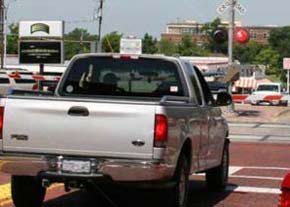
#7. When required to stop at a railroad crossing, you must stop and keep this distance from the nearest rail:
Louisiana law requires that the driver of any motor vehicle must stop within 50 feet but no less than 15 feet from the nearest rail of a railroad crossing when:
- A signal device is flashing, and a train is approaching.
- A crossing gate is lowered.
- A train gives a warning signal and is an immediate hazard due to its speed or nearness to the crossing.
- A train is approaching so close as to create an immediate hazard.
After stopping, the driver shall not proceed to cross the tracks until he can do so safely. Railroad grade crossings are marked with warning devices for your protection. Watch for and respect these devices.

#8. Which of the following must you obey over the other two?
You must obey all lawful orders and Directions given by a police officer. Uniformed school crossing guards also have the authority to direct traffic at locations near schools. You must also respect and obey a flagger in a work zone.

#9. When you approach this sign, you must:
This sign provides advance notice to upcoming speed limit change. Be prepared to slow down.

#10. What does this sign mean?
Left or Through Sign. This sign lets you know that your lane is splitting off into two separate directions. You can turn left or go straight through.

#11. What should you use a center lane with a solid yellow line and a broken yellow line on both sides for?
On many streets where it is difficult to safely make a left turn, there is a shared left turn lane located in the middle of the roadway. The solid yellow center line means you cannot use the center lane for passing. The broken yellow center lines show that vehicles traveling in either direction may use the center lane only to make left turns. Louisiana law prohibits traveling in this lane for more than 200 feet. Do not move into the lane too soon.
If a two-way left turn lane has been provided, do not make a left turn from any other lane.

#12. The risk of hydroplaning increases:
At speeds up to 35 miles per hour (56 km/h), tires with good highway type tread will wipe the road surface the way a windshield wiper cleans the windshield. As speed increases, the water cannot be removed fast enough, and the tires start to ride up on the layer of water like a surfboard. This is called hydroplaning.

#13. Which is true about large trucks?
Generally speaking, the bigger the truck is:
- The bigger its blind spots.
- The more room it needs to maneuver.
- The longer it takes to stop.
- The longer it takes to pass it.
- The longer it takes to get up to speed.
- The more likely you are going to be the loser in a collision.

#14. Backing a vehicle on interstate highways:
Backing up is not permitted on any shoulder or roadway of any controlled-access highway. It is also prohibited at any other place unless it can be done safely without interfering with traffic.

#15. The golden rule of driving is to:
The most important factor in the regulation of the highway transportation system is the driver who obeys traffic laws and follows the golden rule of driving to treat others the way you would want to be treated.

#16. Which is true about the right of way at a 4-way stop?
You must yield the right-of-way to the vehicle that reached the intersection first.
When two vehicles approach the intersection at the same time, the driver on the left must yield the right-of-way to the vehicle on the right.

#17. The Implied Consent Law means that you:
Louisiana law states that when you drive a motor vehicle upon the highways of this state, you are deemed to have given your consent to a test for the purpose of determining the alcohol content of your blood and the presence of any abused or illegal controlled dangerous substance. The test will be administered at the discretion of a law enforcement officer who has reason to believe you were driving under the influence of alcohol or drugs.

#18. According to Louisiana's Move It, Move It, Move It - Steer It Clear campaign, it is your responsibility to:
Louisiana’s Move It, Move It, Move It – Steer It Clear campaign is an attempt to make you aware of your responsibility to remove vehicles from the roadway to the nearest soft shoulder. Removal of vehicles from the roadway will play a great role in reducing traffic congestion and reduce the chances of secondary crashes.
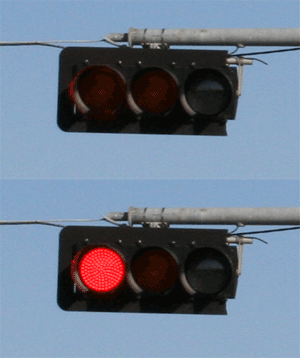
#19. A flashing red light means the same thing as:
A flashing red light means the same as a stop sign.

#20. When you park headed uphill and there is no curb, you should turn your front wheels:
Headed either uphill or downhill and there is no curb, turn the wheels to the right so the car will roll away from the center of the road if the brakes fail.
Remember, when you park on a hill, the general rule is to turn your wheels sharply toward the side of the road or curb. This way, if your vehicle starts to roll downhill, it will roll away from traffic. However, when headed uphill at a curb, you should turn the front wheels in the opposite direction, away from the curb and towards the road. Then, let your vehicle roll backwards until the back of your front wheel touches the curb. The curb will stop your car from rolling into traffic.

#21. As a defensive driver you should:
Expect other drivers to make mistakes and think what you would do if a mistake does happen. For example, do not assume that a vehicle coming to a stop sign is going to stop. Be ready to react if it does not stop.

#22. Which of the following is the best method to improve safety when driving at night?
Reduce your speed so that you can stop within the distance you can see ahead. You should never drive so fast that you cannot stop within the distance you can see ahead with your lights.

#23. To be safe, car tires must have a minimum tread depth of:
Check your tires and air pressure often. Remember, it is not safe to drive on tires with less than 1/16 inch of tread.
Good tire tread helps water escape quickly through the grooves and helps prevent hydroplaning. Worn or bald tires can increase your stopping distance and make turning more difficult when the road is wet. Worn tires also increase the chance of having a flat tire.

#24. You see this sign on the highway. What should you expect ahead?
Divided highway ends. The divided highway on which you are traveling ends 350 to 500 feet ahead. You will then be on a roadway with two-way traffic. Keep to the right.

#25. On highways with several lanes traveling in the same direction, you should use the right-hand lane for:
Traffic moving at less than the normal speed should always use the right lane. the far-left lane should be used as a passing lane.
Louisiana OMV Knowledge Test
Quick facts about the Louisiana knowledge test for learner’s permit and Class E driver’s license:
| Number of Questions: | 40 questions |
| Correct answers needed: | 32 |
| Passing score: | 80 percent |
| Time limit: | N/A |
| Earliest retest upon failure: | Same day (limit two tests per day) |
This Louisiana Sample Knowledge Test
The actual Louisiana knowledge examination has 40 questions. This sample test is limited to 25 random multiple-choice questions in each set. You can take an unlimited number of practice tests with questions drawn from a large question bank.
You will get feedback after each question, and if your answer is incorrect, there is also a short comment to explain some simple facts.
The Real Louisiana Knowledge Test
To pass the official driver examination supplied by the Louisiana Office of Motor Vehicles (OMV), you must correctly answer at least 32 questions. It is a passing score of 80%. On the practice test, that is 20 correct answers, but it is a good idea to aim higher than 80 percent when you study.
If you fail your first attempt at the actual written test, you can retake it the same day but only once.
Generally, you will take your test at a third-party provider or school. OMV will only administer a written test under certain conditions.
Driver Education Course
OMV will issue a Temporary Instructional Permit (TIP) after they have registered your license application.
You must present this temporary permit to an enrolled driver education provider before they give a knowledge test, let you drive during a driving skills instruction, or take an on-road driving skills test.
You must always complete a driver’s education course in Louisiana before OMV issues a driver’s license.
If you are at least 15 years old and less than 17 years, you must complete 30 hours of classroom instruction and 8 hours of behind-the-wheel driving instruction.
If you are 17 years or older and did not enter the graduated licensing program, you must complete a 38-hour education course or a 6-hour licensing course, and an 8-hour behind-the-wheel course.
Holders of a valid driver’s license from the United States, Canada, Germany, Switzerland, or Taiwan are exempt from the education course, knowledge test, and road skills test. Holders of licenses from other countries must complete an approved course and pass all tests.

The Louisiana Class D & E Study Guide
The best study guide for your learner’s permit and adult driver’s license is the official Class D & E Driver’s Guide. It has all the information you need to pass the written examination.
Get a copy from your school, third-party driving school, or OMV office. You can also download a PDF-version online .
OMV recommends reading through the Driver’s Guide at least three times.
Use it together with this practice test.
Take as my tests as you need to feel comfortable with all questions and answers. Try to fully understand why some choices are correct and why some are not.
Remember always to read each question and the answer choices all the way through. Pace yourself, and don’t pick the first answer that looks right. Most mistakes on an actual test are made because the test taker tried to finish as quickly as possible and didn’t pay enough attention to the wording of each question.
