
Florida Permit Practice – Driver’s License Sample Test Questions
Results
Great job! You have reached the passing score. Do you want to try again?
This is not a passing score. Do you want to try again?




#1. You see a sign with this shape from a distance. What should you expect ahead?
This three-sided sign is shaped like a pennant. The sign indicates the start of a no passing zone.

#2. The main reason why drinking alcohol and then driving is so dangerous is that it affects your:
Alcohol affects those areas of your brain that control judgment and skill. This is one reason why drinking alcohol is so dangerous – it affects your judgment. Good judgment is important to driving, but in this case, judgment helps you to know when to stop drinking.

#3. To avoid last-minute moves, you should:
Good driving is based on practice and being alert at the wheel. You must look down the road, to the sides and behind your vehicle and be alert for unexpected events. Be alert to what is going on around you and do not take your eyes off the road for more than a few seconds at any one time.

#4. How long is your braking distance when you increase your speed from 20 to 80 mph?
High speeds greatly increase stopping distances and severity of crashes. The faster you drive, the greater the impact or striking power of your vehicle.
- Double your speed from 20 to 40 MPH, the braking distance and impact are 4 times greater.
- Triple the speed from 20 to 60 MPH, the braking distance and impact are 9 times greater. (Stopping distance is equal to a football field.)
- Quadruple your speed from 20 to 80 MPH, the braking distance and impact are 16 times greater.

#5. Drivers entering a roundabout:
Drivers entering the roundabout must yield to traffic already in the circle and are directed in one-way, counterclockwise direction.

#6. When approaching a stopped school bus that is picking up or dropping off children and traveling on your side of an undivided highway with four or more lanes, you must:
On a two-way street or highway, all drivers moving in either direction must stop for a school bus picking up or dropping off children. You must remain stopped until all children clear the roadway and the stop arm is withdrawn.
If the highway is divided by a raised barrier or an unpaved median at least five feet wide, you do not have to stop if you are moving in the opposite direction of the bus.
Remember, painted lines or pavement markings are not considered barriers.

#7. What does this sign mean?
This is a regulatory sign, indicating you must keep right.
At locations where it is not readily apparent that traffic is required to keep to the right, this sign tells you to pass only to the right-hand side of a roadway feature or obstruction. Placed at raised medians, parkways, islands, and underpass piers. The sign can be reversed (Keep Left).

#8. Where are traffic crashes involving motor vehicles most likely to occur?
More crashes happen at intersections than any other place. Be careful when approaching any intersection or driveway.

#9. The minimum age that a person must be to obtain their first restricted learner's license is:
To earn a learner license, you must be at least 15 years old.

#10. You are following a school bus, and there is a railroad crossing ahead. You must slow down and prepare to stop because the bus:
Always approach highway-railroad crossings at a reasonable speed and stop if indicated by signs or signals. Be especially alert and leave extra room when you are following buses or trucks, which may have to stop at highway-railroad crossings even when gates are up and the warning lights are not flashing.
The law specifies:
- Any motor vehicle carrying passengers for hire, excluding taxicabs.
- Any school bus carrying any school child.
- Any vehicle carrying explosive substances or flammable liquids.
316.159

#11. Which road signs have this shape?
The upside-down triangle shape is exclusively used for yield signs. Slow down and, if necessary, stop to give the right of way to vehicles and pedestrians.

#12. You approach this intersection. Which lane can you use for a right turn?
Arrows are often used with the white lines to show which turn may be made from the lane. If your lane is marked with both a curved and straight arrow, you may either turn or go straight. If you are in a lane marked with a curved arrow and the word ONLY, you must turn in the direction of the arrow.

#13. What does a traffic signal with a flashing yellow light mean?
A flashing circular yellow light means you may move forward with caution. It is used at, or just before, dangerous intersections, or to alert you to a warning sign such as a school crossing or sharp curve.

#14. You see this sign ahead. What should you do?
Winding road. There are several curves ahead. Drive slowly and carefully.

#15. What does this sign mean?
Sharp turn. The road will make a sharp turn. Slow your speed, keep to the right, and do not pass other vehicles.

#16. When you park on a hill headed uphill, and there is no curb, you should turn your front wheels:
Headed either uphill or downhill and there is no curb, turn the wheels to the right so the car will roll away from the center of the road if the brakes fail.
Remember, when you park on a hill, the general rule is to turn your wheels sharply toward the side of the road or curb. This way, if your vehicle starts to roll downhill, it will roll away from traffic. However, when headed uphill at a curb, you should turn the front wheels in the opposite direction, away from the curb and towards the road. Then, let your vehicle roll backwards until the back of your front wheel touches the curb. The curb will stop your car from rolling into traffic.
Study the diagram provided in your driver’s handbook.
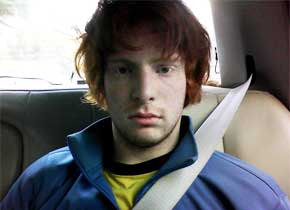
#17. A car passenger under 18 years must wear a seat belt or child restraint:
Florida law requires that all drivers, all front seat passengers, and all passengers under the age of 18 wear seat belts. Children under age 4 must be in a safety seat, and children ages 4 and 5 must be in either a safety seat or a booster seat.

#18. The driver in front of you signals (left arm extended, with elbow bent upward, at about a 90-degree angle):
Right turn – left arm extended, with elbow bent upward, at about a 90-degree angle.

#19. A truck's blind spots:
No-zones are danger areas around trucks and buses where crashes are more likely to occur.
When driving near a large vehicle, be aware of the driver’s blind spots on the right, left, front and behind. Avoid following too closely and position your vehicle so the truck driver can see you in his side mirrors. Then you will have a good view of the road ahead, and the truck driver can give you plenty of warning for a stop or a turn. You will have more time to react and make a safe stop.

#20. You need written proof of insurance coverage:
As a condition of driving, you must be able show proof of insurance.

#21. When an emergency vehicle using flashing lights approaches you from behind, you must:
You must yield the right-of-way to law enforcement vehicles, fire engines and other emergency vehicles using sirens and/or flashing lights. Pull over to the closest edge of the roadway immediately and stop until the emergency vehicle has passed. Do not block intersections.

#22. To prevent skidding on slippery surfaces, you should:
Skids are caused by drivers traveling too fast for the conditions. Most skids happen when you try to turn or stop suddenly on slippery pavement. Keep your tires on the road by slowing down when it rains and having tires with the proper air pressure and good tread.

#23. You must NOT pass another vehicle on the left side of the road:
Do not pass on hills or curves.
By Florida law, you must not drive to the left side of the roadway when approaching or upon the crest of a grade where your view is obstructed within such distance as to create a hazard in the event another vehicle might approach from the opposite direction.

#24. What should you do if you feel tired and nothing seems to help you stay awake while driving?
Stop driving when you feel tired. On long trips, the engine’s hum and your lack of movement can make you sleepy. Stop for a cup of coffee, a short walk, or a nap. Do not risk falling asleep at the wheel.

#25. If you are involved in a traffic crash, and someone is injured, it is generally wrong to:
Do not give an injured person something to drink, not even water.
Florida FLHSMV Driver Knowledge Exam
Quick facts about the Florida Driver’s License Class E Knowledge Exam for learner’s permit and driver’s license:
| Number of Questions: | 50 questions |
| Correct answers needed: | 40 |
| Passing score: | 80 percent |
| Time limit: | N/A |
| Earliest retest upon failure: | Same day (new fee) |
This Florida Sample Test
While the actual Florida knowledge examination has 50 questions in each set, this practice test will show you 25 random multiple-choice questions in each set. You can simulate the real exam by taking two tests in a row.
Florida used to have two tests, one road sign recognition test and one test about road rules. These tests are now combined into one and expanded with ten additional questions. Questions are updated regularly and always random, which means that no two tests are identical.
To pass the Florida Permit Exam, you must correctly answer at least 40 questions, a passing score of 80%.
If you fail your first attempt at the test, you can retake it the same day.
How to Prepare for the Florida Permit Test
To prepare for your Knowledge Exam, study the Official Florida Driver’s License Handbook. You can get a hard copy at your local service center or tax collector . You can also download the PDF-version online and keep it handy on your computer or smartphone.
Take many of the Class E knowledge practice tests. They will help you understand what questions you will see on the exam and tell you whether you are ready for the real thing. Aim for a full score on a handful of practice tests before you attempt the real one.
Surveys show that this Florida permit practice helps.
Where to Take the Real Test
Note that this website does not offer the authentic examination, only the Florida permit practice.
If you are 18 years or older, you usually take the test in person at one of DHSMV service centers. The test is given on a computer, and you cannot bring books into the testing area or use a cell phone during the test.
If you are still in high school, you probably already know that many high school driver education classes are authorized to provide the knowledge exam (known as DELAP). If you pass the test in an approved public or private school course, the result is forwarded to FLHSMV’s test records.
Minors under 18 can also take the test online at approved third-party administrators. A Parent Proctoring Form is required for these online tests, and this form must be notarized or signed in the presence of a driver’s license examiner.
You cannot take the online test from home.
Is the Florida Knowledge Test Hard?
In 2015, the failure rate was a staggering 60%. Since then, the state has changed many questions, and the goal is to have a 70 percent passing rate.
The difficulty level is rated “moderate.” It is not the most straightforward test in the United States, but it is also not the most challenging.

What Happens if You Fail the Test?
Florida has no official wait time for retesting, but most examiners will recommend you wait at least one day before retaking the test.
If you missed more than ten questions on the exam, you were probably not ready. Remember, a permit or driver’s license is a privilege that comes with significant responsibilities. It should not be taken lightly.
What Happens if You Pass the Test?
After submitting all necessary documents and passing the exams, including the Traffic Law and Substance Abuse Education (TLSAE) course, FLHSMV will issue a learner’s license.

With a learner’s permit, you can start practicing your driving skills.
When you sit behind the wheel, you must always carry your permit. You must also be accompanied by a driver who:
- Holds a valid license to drive this type of vehicle
- Is at least 21 years of age
- Occupies the closest seat to the right of you
Under no circumstances can you drive alone.
Restrictions on Your Learner’s Permit
You may only drive during daylight hours for the first three months after the permit is issued. After three months, you may drive until 10 p.m.
You must hold your learner’s permit for a minimum of 12 months or until your 18th birthday, whichever comes first.
Frequently Asked Questions
What is the passing score on the Florida permit exam?
To pass the Florida Permit Exam you must correctly answer at least 40 out of 50 questions, a passing score of 80%.
How long must you wait before you can take Florida permit exam again?
If you fail your first attempt at the test, you can retake it the same day. You must, however, pay the testing fee each time you retake the test.
How should I prepare for the Florida permit test?
To prepare for your Knowledge Exam, you should start by studying the Official Florida Driver License Handbook and take many practice tests.
How old must I be to take the Florida permit test?
To apply for your first Florida learner’s license, you must be at least 15 years old.
Where can I get the official Florida Driver License Handbook?
You can get a hard copy from all DHSMV service centers. You can also download a PDF-version from FLHSMV's website. You should not download it from privately owned websites.
What is a TLSAE course?
TLSAE is a Traffic Law and Substance Abuse Education course. All drivers who have not been licensed before must complete TLSAE course before applying for a license in Florida. Drivers under 21 years with suspension for driving with a blood alcohol level (BAL) of .02 to .05 must complete the course.
What are the night driving restrictions on a Florida Learner's License?
A holder of a Florida Learner's License can only drive during daylight hours for first three months. After three months they may drive until 10 p.m.
Can I take the Florida permit exam online from home?
You cannot take a Florida online test from home. Online testing is only offered by approved third party administrators.
Is there a time limit on the Florida permit exam?
There is no time limit, but you are not allowed to begin the test if it cannot be completed before closing (usually 30 minutes before closing).
