
Arkansas Driver’s License Practice Test – 25 Questions
Results
Well done. This is a passing score. Do you need more practice?
This is not a passing score. Do you want to try again?




#1. You approach this sign. What should you do?
Traffic signal ahead. Slow down and be prepared to stop, if necessary.

#2. What do pavement markings in the center of this road indicate?
Shared center lanes are reserved for making left turns and can be used by vehicles traveling in either direction.
Lanes are marked on each side by solid yellow and dashed yellow lines.
In Arkansas it is permissible for a vehicle making a left turn from an intersecting street or driveway to utilize a center left turn lane as part of the maneuver to gain access or merge into traffic lanes. It is not permissible to use the center left turn lane as an acceleration lane.

#3. When can you park on the roadside of another parked vehicle (double parking)?
Parking along the street or highway next to another parked vehicle (double parking) is not allowed.

#4. When making a left turn, you should:
Make sure it is safe to turn. If you are turning left, make sure there are no vehicles or pedestrians blocking your path. You do not want to be caught waiting for a path to clear while being stuck across a lane that has an oncoming vehicle moving in your direction.
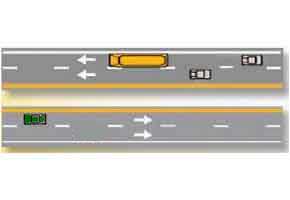
#5. If you meet a school bus traveling in the opposite direction on a four-lane highway separated by a median 20 feet in width and the bus is displaying a stopped signal, you must:
If the highway is divided by a median at least 20 feet wide, you do not have to stop if you are moving in the opposite direction of the bus.

#6. The two-second rule is a way for you to determine:
There is an easy way to tell if you are following too closely. It is call the two-second rule, and it works at any speed. There are situations where you need more space in front of your vehicle. In these situations, you may need a four second following distance to be safe.
Remember, the two-second rule does not mean that you are able to stop within two seconds.

#7. When someone tailgates you, the risk of a collision increases if you:
Occasionally, you may find yourself being followed closely or tailgated by another driver. If another driver follows you too closely and there is a right lane, move over to the right. If there is no right lane, wait until the path ahead is clear then reduce speed slowly. This will encourage the tailgater to drive around you. Never slow down quickly to discourage a tailgater, which may increase the risk of being hit from behind.

#8. When you see this sign, you should:
Cross road or intersection. A road crosses the main highway ahead. Watch for other vehicles entering or leaving the highway.

#9. This sign provides the public with critical emergency contact information at all highway intersections.
The purpose of the ENS sign is to provide the public with critical emergency contact information at every highway-rail grade crossing. The information contained on the ENS sign enables the public to reach the railroad responsible for the crossing and to identify the specific crossing in the event of an emergency.

#10. What does the red color on a road sign indicate?
All red signs are regulatory signs and must be obeyed. They indicate stop or prohibition and include signs like: stop, yield, do not enter and wrong way.

#11. How do seat belts help you when you drive?
If your vehicle is hit from the side, your body will be thrown toward the side that is hit. Your lap and shoulder belts are needed to help keep you behind the wheel. Get ready to steer or brake to prevent your vehicle from hitting another object.

#12. When a traffic signal is showing a steady red light:
Traffic facing a steady circular red signal must stop.
After stopping, a driver may turn right on red at the intersection of two-way streets, or may turn left on red from a one-way street to another one-way street. These turns may be made after yielding to all other traffic and pedestrians, and if no signs are posted to prohibit them.

#13. To avoid getting tired on a long trip, you should:
There are things you can do to help from getting tired on a long trip:
- Try to get a good night’s sleep before you leave.
- Do not leave on a trip if you are already tired.
- Do not take any medicine that can make you drowsy.
- Eat light meals. Do not eat a large meal before you leave. Large, full meals tend to cause drowsiness.
- Take breaks. Stop regularly or as needed.
- Plan for plenty of time to complete your trip safely.
- Avoid long trips during hours your body is accustomed to resting.
Remember, never drive if you are sleepy.

#14. A large truck turns right onto a street with two lanes in each direction. The truck:
Trucks make wide right turns and sometimes must leave an open space to the right just before the turn. To avoid an accident, do not pass a truck on the right if there is a possibility it might make a right turn.

#15. Under the graduated licensing law, no serious moving violations are allowed for those under 18 during what phase?
When applying for a learner’s license or an intermediate license, the applicant must not have been at fault in traffic crash or been convicted of a serious traffic violation within the preceding six month period prior to application.
To be eligible for a full license, the applicant must not have been at fault in connection with a traffic crash or been convicted of a serious traffic violation within the preceding twelve months prior to application.

#16. If you plan to turn after an intersection, you should:
Do not confuse other drivers by signaling too early. If there are streets, driveways, or entrances between you and where you want to turn, wait until you have passed to signal.

#17. During hot summer days, the temperature inside a parked vehicle:
Every summer we read tragic stories of children or pets dying due to drivers who left them unattended inside a hot vehicle. Even with the windows partially open, temperatures rapidly rise to deadly levels inside a vehicle parked in direct sunlight.

#18. A white cloth tied to a radio antenna or a door handle indicates:
Lift the hood and tie a white cloth to the antenna, side mirror or door handle to signal an emergency.

#19. If your vehicle starts to skid or hydroplane, you should:
If your vehicle begins to skid, stay calm and ease off the gas. Stay off the brake. Until the vehicle slows, your brakes will not work and could cause you to skid more. Turn the steering wheel in the direction you want the vehicle to go. As soon as the vehicle begins to straighten out, turn the steering wheel back the other way. If you do not do so, your vehicle may swing around in the other direction and you could start a new skid. Continue to correct your steering, left and right, until the vehicle is again moving down the road under your control.

#20. In general, you should avoid using your horn:
Don’t use your horn:
- To encourage other vehicles to speed up
- To inform other drivers of a mistake
- To greet a friend on the road
- Blind pedestrians.

#21. Which of the following is unsafe driving on a limited-access highway?
Do not block the passing lane.
On multi-lane roads, the left-most lane is intended to be used to pass slower vehicles. If you move slower than the traffic flow or are being followed too closely and there is a right lane, move over to the right.
This question asked what is NOT a safe driving practice.

#22. Your headlights will let you see about 400 feet ahead. When it is dark, you should drive at a speed that allows you to stop within this distance, or about:
Your headlights will let you see about 400 feet of dark road. You should drive at a speed that allows you to stop within this distance, or about 50 mph.

#23. This sign tells you:
No U-Turn.
You cannot make a complete turn to go in the opposite direction where this sign is displayed.
Remember that a red circle with a slash means no. The sign shows you what is not allowed.

#24. How do the following compare in alcohol content 12 ounces of beer, 1.5 ounces of 80-proof liquor, and five ounces of wine:
It is not what you drink, it is how much. A single alcohol drink is considered 1.5 ounces of 80-proof liquor (one shot glass) straight or with a mixer, a 5 ounce glass of wine or a 12 ounce container of beer. Specialty drinks can have more alcohol and one drink may equal several normal drink.

#25. You approach a motorcycle in the same lane. When passing you must:
When passing a motorcycle, allow a full lane to the motorcycle. Never crowd into the same lane as the motorcycle. Returning to the original lane too soon can force a rider to swerve to the right into traffic or off the road.
Arkansas State Police Driver’s License Knowledge Test
Quick facts for your Arkansas driver’s license test:
| Number of Questions: | 25 |
| Correct answers needed: | 20 |
| Passing score: | 80 percent |
| Time limit: | No limit |
| Earliest retest upon failure: | 1 day |
What You Should Know about the State Police Knowledge Exam
The test consists of 25 multiple-choice and true-or-false questions given on a computer. You need 20 correct answers to pass the examination.
Exam questions are randomly chosen from a larger group of questions, meaning you will not get the same exam twice.
Should you fail your test, you can retake it the next day – but it may be a good idea to wait longer and reread the Study Guide. Use practice tests to verify your knowledge.
State police charge a new fee every time you want to take the test, so it is a good idea to pass it the first time. It also saves you money and unnecessary trips to a test location.
The written test is available in English and Spanish only.
If you speak another language, you may bring a dictionary of English to your native language to the test. Unlike many other states, Arkansas does not allow you to have an interpreter with you for the knowledge exam.
Arkansas does not offer any online testing from your home.
Is the Arkansas Knowledge Test hard?
Official failure rates show that almost 50% of all first-time test takers fail the exam.
The difficulty of the Arkansas examination is graded hard.

What You Should Know about the Arkansas Driver’s License Practice Test
A practice test does not replace the Arkansas Driver’s License Study Guide. To pass the test, you must read the study guide and understand the Arkansas road rules.
Use practice tests as a supplement only.
Just like the real exam, each practice test is random, and each test will generate a new set of 25 questions.
You can repeat the practice test as often as you want.
After each question, you will get instant feedback. If your answer is incorrect, there is also a brief explanation. Answers to questions can be found in the Study Guide.
Aim for a full score on each practice test.
What Happens if You Fail the Written Examination?
If you fail the examination, you can generally retake the test the next business day.
A new fee is required every time you take the test.
What Happens After You Have Passed the Written Examination?
As a first step, Arkansas state police always issue an instruction permit. The permit allows you to practice driving together with a supervising driver who is licensed and at least 21 years old.
When you practice driving, you must always have the instruction permit, and the supervising driver must sit in the front seat beside you.
All passengers must wear seat belts, regardless of seating position.
You cannot use a cell phone or any other wireless device, including hands-free devices while driving unless it is for emergency purposes.
The permit is valid for one year and cannot be extended.
