
Colorado Driver’s License and Permit Practice Tests
Results




#1. When should you share a lane with a motorcyclist?
Motorcycles are entitled to the same full lane width as other vehicles. Never try to pass a motorcycle in the same lane. Passing or overtaking a vehicle in the same lane is illegal in Colorado.

#2. The amount of alcohol in 1.5 ounces of 72-proof liquor is generally equal to:
It is important to remember that it does not make any difference whether you drink beer, wine or liquor. Standard servings of each have the same amount of alcohol. A standard drink is defined as 12 ounces of beer, 5 ounces of wine, or 1.5 ounces of 72-proof distilled spirits, all of which contain the same amount of alcohol.

#3. When a school bus flashes red lights, you must stop:
If you are traveling on a roadway without a median, traffic in both directions are required to stop.

#4. When approaching a stopped school bus with flashing red lights traveling on your side of a divided highway, you must:
You must stop your vehicle at least 20 feet before reaching a school bus that is stopped with its red lights flashing whether it is on your side of the road, the opposite side of the road, or at an intersection you are approaching.
You are not required to stop if the bus is traveling toward you on a roadway that is separated by a median or other physical barrier.

#5. A Crossbuck sign at a railroad crossing means:
A Crossbuck sign should be treated the same as a yield sign. If there is more than one track, a sign below the crossbuck indicates the number of tracks at this crossing.

#6. When two vehicles from different directions arrive simultaneously at an intersection with no signs or signals, which should have the right-of-way?
When more than one vehicle reaches the intersection at the same time the vehicle on the left must yield the right-of-way and allow the vehicle on the right to go first.

#7. If you are involved in a traffic crash, and someone is injured, you must always:
If any person is injured or killed, the police must be notified.
Do not move the injured unless the injured person’s life is endangered. Moving a person can make injuries worse.

#8. An adult driver will lose the driver's license through a point suspension after 12 points in any 12 consecutive months, or:
If you accumulate too many points against your driving record within a certain period of time, you will lose your driver’s license through a point suspension. An adult driver will lose the driver’s license after 12 points in any 12 consecutive months, or 18 points in any 24 consecutive months.

#9. If you run off the pavement, you should:
If your right wheels run off the pavement edge, do not use your brakes. Do not try to pull sharply back onto the pavement. Take your foot off the accelerator, steer straight ahead, straddling the pavement edge, until the car has almost stopped. Then turn and guide your car back onto the road.

#10. Where is it always illegal to park or stand a vehicle?
It is forbidden to stop or park a vehicle blocking a driveway.

#11. What should you do when you see this sign?
Move or merge right. Flashing arrow boards are often used to indicate a detour or crossover. In these cases, lane markings on the road, traffic cones, barrels or barricades will outline the path a vehicle must follow.
Drivers are responsible for knowing how to read and react to work zone directional signs.

#12. After passing a large truck, you should:
Look for the entire front of the truck in your rear view mirror before you pull in front, and then maintain speed. Do not slow down.

#13. The driver ahead signals:
Right turn – left arm extended, with elbow bent upward, at about a 90-degree angle.

#14. When something obstructs your view, the law prohibits passing another vehicle:
Do not pass within 100 feet of any bridge, viaduct, or tunnel when view is obstructed.
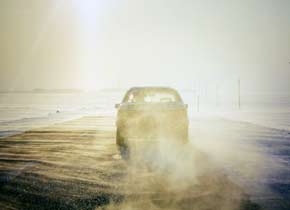
#15. What parts of a road can be icy in winter even when the rest is dry?
Overpasses, bridges, shaded areas and snow packed portions of the road can be icy even when other pavement is not.

#16. When should you drive with only your parking lights turned on?
Whenever it is necessary to drive with your lights on, you must use your headlights. Do not drive with your parking lights.

#17. Emotions affect your driving. If you feel angry, excited, or upset, you should:
Emotions can have a great effect on safe driving. You may not be able to drive well if you are overly worried, excited, afraid, or angry. Keep cool or let somebody else drive. Do not transfer the anger you may feel from other situations into your driving.

#18. What is the proper way to use anti-lock brakes in an emergency?
The ABS system allows you to stop without skidding. Press on the brake pedal as hard as you can and keep pressing on it. Do not let up on the brake pedal.

#19. It is especially important to look for vehicles behind you when you:
You must check traffic behind you. This is the only way to know if someone is following too closely or coming up too quickly, and it will give you time to do something about it. You need to check more often when traffic is heavy. It is very important to look behind you when you change lanes, slow down, back up, exit an intersection or drive down a long or steep hill.

#20. A solid green signal light means:
A green light means Go.
You may proceed straight through or turn right or left unless a sign prohibits such turns. However, you must yield to any vehicle or pedestrian within the intersection or adjacent crosswalk.

#21. Pavement in center left-turn lanes is marked on both sides with:
Many two-way streets have a center lane marked as a two-way left turn lane. This lane is bordered on either side by two yellow lines – the inner line is broken, the outer line is solid. These lanes are reserved for turning and are used by vehicles traveling in both directions.
You may turn into or from the road using this lane. You may stop in this lane until it is safe to complete the turn. When a street has a shared center turn lane, you may not turn left from any other lane. This lane is not to be used to pass another vehicle.

#22. When driving past this sign:
Wrong Way. The sign prohibits drivers from heading the wrong way on a one-way street or freeway ramp. If you drive past this sign, you have entered a lane of oncoming traffic and are going against traffic. Do not continue.

#23. You approach this advisory speed sign. It informs you of:
Exit and entrance signs at freeway ramps display the maximum recommended safe speed to drive while on the ramp under ideal weather conditions. The advisory speed sign is not a regulatory speed limit.

#24. What does this sign mean?
Side Road Ahead sign. It tells you that there is an intersection ahead. Watch out for traffic entering from the side road and oncoming traffic turning.
#25. You may park your vehicle in a disability parking space:
Disabled parking signs mark special parking areas for only those vehicles displaying a disabled parking permit. In order to park in a disabled parking space, the person who owns the disabled placard must be entering or exiting the vehicle. If you park illegally in a designated disabled parking spot without a placard or plate, you could be charged with a misdemeanor, and if convicted, subject to a fine, possible jail time, loss of driving privileges and/or your car being impounded.

#26. What color are traffic signs that guide you to motorist services?
Service signs have blue backgrounds and provide directions to service facilities such as telephones, gas, food, motels, hospitals, and rest areas.
Colorado DMV Knowledge Test
Quick facts for your Colorado driver’s license and permit test:
| Number of Questions: | 25 |
| Correct answers needed: | 20 |
| Passing score: | 80 percent |
| Time limit: | None |
| Earliest retest upon failure: | 1 day |
Prepare for the Colorado Permit Examination
The permit examination has 25 multiple-choice and true-or-false questions. You need 20 correct answers to pass the test (80%).
Your test questions are randomly picked from a larger group of questions, which means you don’t know which questions you will get. The more you practice, the better your chances of passing the test the first time.
If you fail the knowledge examination, you can try the next business day again. That may be an acceptable strategy with just minor errors, but having six or more errors on the test means you missed a large portion of the exam. It is better to wait a few more days and read the Driver Handbook again.
Everything you need to learn for the exam is in the handbook, so don’t forget to get a hard copy or download the PDF file to your computer or smartphone.
This Colorado driver’s license test has 25 questions, just like the real permit exam, and it covers everything you need to learn to pass.
Practice tests should always be an additional learning tool when preparing for the permit test, not a replacement for the handbook. Some websites suggest you can pass the test by studying practice tests and cheat sheets, which is a bad strategy. Use both sample tests and the handbook, and you will have a much better chance of passing your exam the first time.
Read more about risky study tactics that could cause you to fail
Is the Colorado DMV Permit Test Hard?

The latest numbers show that almost one-third of all test takers fail the examination. It means that the difficulty is moderate to hard.
It is, however, suggested that the test has become easier in recent years.
Colorado Instruction Permit – Under 18 years
These are the requirements to get your first permit as a teenager:
| Be at least 15 years |
| Present a completed “Affidavit of Liability and Guardianship” |
| Prove full legal name, age, identity, and Colorado residency |
| Prove lawful presence in United States (if applicable) |
| Pass a vision exam |
| Pass the written knowledge exam |
Additional Requirements for permit issuance at 15 years to 16 years:
Permit issued at 15-15 1/2 years, license at 16-16 1/2 years:
- 30-hour driver’s education course completed within six months before permit issuance
- 6 hours behind the wheel training with an instructor after permit issuance
Permit issued at 15 1/2-16 years, license at 16 1/2-17 years:
- 4-hour classroom driver awareness program completed within six months before permit issuance
Colorado Instruction Permit – 18 years or older
These are the requirements to get your first permit as an adult:
| Be at least 18 years |
| Prove full legal name, age, identity, and Colorado residency |
| Prove lawful presence in United States (if applicable) |
| Pass a vision exam |
| Pass the written knowledge exam |
After You Pass the Knowledge Examination
After you have provided the necessary documents and passed both the vision exam and the knowledge test, you may start practicing driving.
If you are under 18 years, you can drive with a licensed driving instructor or any licensed adult 21 years or older. You must complete and log 50 hours of driving time, of which 10 hours must be at night. Only the person who signs the affidavit can certify your driving log.
Your First Colorado Driver’s License – Under 18 Years
These are the requirements to get your first Colorado driver’s license as a teenager:
| Hold your permit for at least 1 year |
| Provide a certified log of at least 50 hours of driving practice |
| Pass the vision exam (again) |
| Successfully pass driving test |

Your First Colorado Driver’s License – 18 years or older
These are the requirements to get your first Colorado license as an adult:
| Pass the vision exam (again) |
| Successfully pass driving test |
If you are 18 years or older, there is no minimum time to hold your permit before applying for a driver’s license.
