
Alabama Permit Test Practice – 30 Questions
Results
There is a bit left to a passing score. Try again?




#1. When are two regular solid white lines used as pavement marking?
Double solid white lines indicate that lane changes are prohibited.

#2. You may only overtake another vehicle on the right on a two-lane, two-way roadway if:
Passing on the right is permitted when the vehicle in front of you is making or about to make a left turn or when the road is marked for two or more lanes of traffic moving in the same direction.

#3. To be convicted of DUI (Driving Under the Influence) if you are 21 or older, your BAC level:
A driver can register a BAC of .00 percent and still be convicted of a DUI. The level of BAC does not clear a driver when it is below .08 percent.
Under state law, it is unlawful for any of the following persons to operate or be in actual physical control of a vehicle:
- A person who is under the influence of alcohol or drugs.
- A person who is under the influence of a drug to a degree which renders him incapable of safely operating a motor vehicle.
- A person whose blood contains .08 percent or more concentration of alcohol.
- A person under the combined influence of alcohol and a drug to a degree which renders him incapable of safely driving.
- Commercial vehicle operators whose blood alcohol content is .04 percent or more.
- Persons under 21 years of age whose blood alcohol content is .02 percent or more.
- School bus and daycare drivers whose blood alcohol content is .02 percent or more.

#4. Which of the following equipment is allowed on your private vehicle?
Muffler cutouts, bypasses or similar devices are forbidden. Bells, sirens or exhaust whistles may not be used except for emergency vehicles. Red or blue lights showing from the front may not be used on a private car.

#5. Which is an appropriate restraint system for a child weighing less than 20 pounds?
The new Alabama law requires children to be in rear-facing infant car seats until they are one year or weigh 20 pounds. After that, they must be in forward-facing child car seats until they are five or weigh 40 pounds, in booster seats until they turn six, and in regular seat belts until they turn 15.
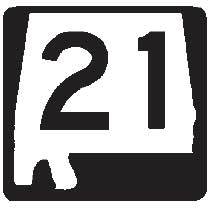
#6. This is an example of:
This is an example of a State Route sign.
The shape and color of route number signs indicate the type of roadway: interstate, U.S., state, city, or county road. When planning a trip, use a road map to determine your route. During the trip, follow the route signs to prevent you from getting lost.

#7. Night driving is more dangerous than daytime driving because:
Approximately half the fatal motor vehicle crashes in Alabama occur during the hours of darkness. Most of the contributing factors in night-time crashes are directly or indirectly involved with vision.
You should never drive so fast that you cannot stop within the distance you can see ahead with your lights.

#8. On a divided four-lane roadway separated by a physical barrier, you must stop for a stopped school bus with flashing red lights traveling in the opposite direction:
A stop is not required on a divided highway having four or more lanes which permits at least two lanes of traffic to travel in opposite directions when meeting a school or church bus which is stopped in the opposing roadway or if the school or church bus is stopped in a loading zone which is a part of or adjacent to such highway and where pedestrians are not permitted to cross the roadway.

#9. When driving beside a motorcycle, you should:
Don’t share the lane with a motorcycle. Motorcycles are entitled to the same full lane width as all other vehicles. A skilled motorcycle operator is constantly changing positions within a lane to maximize being seen, to see the roadway better, and to compensate for objects on or near the road. Drivers should never move into the same lane alongside a motorcycle even if the lane is wide and cyclist is riding far to one side. It is not only illegal, but extremely hazardous.

#10. Hand signals or the vehicle's turn signals should be used when:
Before you stop, turn or change lanes, let the other drivers know what you are going to do by signaling. You can signal with your hand and arm or with your vehicle’s turn signals and brake lights. Signals are required while stopping, turning, changing lanes or suddenly decelerating a vehicle.

#11. What does this sign mean?
Blue signs direct you to motorist services such as telephones, gas, food, motels, hospitals, and rest areas. This will direct you to a lodging facility.

#12. When driving at higher speeds, which method helps you determine a safe following distance between you and a vehicle ahead?
There is an easy way to tell if you are following another vehicle too closely. It is called the two-second rule and it works at any speed.
If the road and weather conditions are not good, increase your following distance to a four or five second count. The increased following limit also applies if you drivevehicles with longer lengths than cars.
Remember, the two-second rule does not mean that you are able to stop within two seconds.

#13. The first thing usually affected by drinking alcohol is:
The first thing affected after drinking alcohol is your judgment.
Remember:
- Alcohol retards judgment.
- Alcohol slows down reflexes.
- Alcohol impairs vision.
- Alcohol causes loss in coordination.
- Alcohol destroys inhibitions.
- Alcohol promotes over-confidence.
- Alcohol prevents concentration.

#14. If you are in an intersection when an emergency vehicle with flashing lights approaches from behind, you should:
If you are within an intersection, including a roundabout, clear it before you pull over.
Remember, you must stop clear of any intersection, and remain stopped until the emergency vehicle has passed.

#15. To back up on a freeway or limited-access highway:
If you miss your exit you must not stop, back up, or attempt to turnaround. Proceed to the next exit and come back to the one you missed.

#16. A right turn against a solid red light is allowed:
You must come to a complete stop when traffic signal shows a red light. Wait until the signal changes to green and the way is clear before proceeding.
You may make a right turn after stopping for a red light if you are in the proper lane for such turn.
You may make a left turn after stopping if you driveon a one-way street and the street you turn left onto is a one-way street with traffic moving from right to left.
In the case of both right and left turns after stopping for a red light, you must yield to other traffic and pedestrians lawfully proceeding through the intersection. Such turns cannot be made against a red light if a sign has been posted prohibiting such turn.

#17. What is the first thing you should do when a conventional rear-wheel drive vehicle starts to skid?
Take your foot off the accelerator or brake pedal, whichever is being applied, to regain vehicle balance.
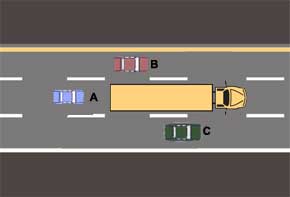
#18. Which car or cars are driving in the truck's blind spots?
Do not hang out on either side of trucks or buses! They have large blind spots on both sides, especially on the right-hand side. If you cannot see the driver’s face in the truck’s side-view mirror, the driver cannot see you. Unlike cars, trucks and buses also have huge blind spots directly behind them. There may also be a large blind spot directly in front of the cab.

#19. When parking at a railroad crossing, you must keep the following distance from the crossing:
Parking is not allowed within 50 feet of the nearest rail of a railroad crossing.

#20. If it is raining when you approach this sign, you should:
Slippery when wet. The road surface is slippery when it is wet.
Exercise extreme caution when road surfaces are slippery from rain, snow, or ice. In a standard passenger car, partial hydroplaning starts at about 35 mph and increases with speed to about 55 mph, at which point the tires may be totally on the water. In a severe rainstorm the tires lose all contact with the road at 55 mph. If this is the case, there is no friction available to brake, accelerate, or corner. A gust of wind, a change of road pitch or a slight turn can create an unpredictable and uncontrollable skid.

#21. If you are convicted of failure to yield the right of way, it will result in the following points on your driving record:
Failure to yield right of way will result in five points on your driving record.

#22. A Crossbuck sign at a railroad crossing has the same meaning as:
A Crossbuck sign should be treated the same as a yield sign. If there is more than one track, a sign below the crossbuck indicates the number of tracks.
Remember, trains cannot stop quickly. A freight train traveling at 55 mph takes a mile or more to stop. That is the length of 18 football fields.

#23. If you are involved in a traffic crash, you must:
If there is injury to or the death of any person, or damage to a motor vehicle, you must stop at the scene of the accident or as close thereto as possible ( 32-10-1).
You must give your name, address and the registration number of your car to another driver. You must also show your driver’s license.
You should also be able show proof of insurance.
If there is injury or death, you must call the local police, the county sheriff, or the state highway patrol.
You must also render reasonable aid to any person injured in such accident.
Remember, after being involved in an accident, proceed only after complying with procedure defined by law.
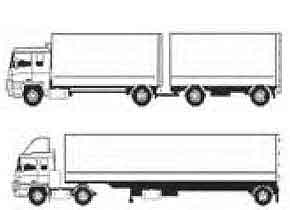
#24. What classified Driver's License do you need to drive a combination of vehicles exceeding 26,000 pounds and where the vehicle being towed exceeds 10,000 pounds?
Class A applies only to combination vehicles with a Gross Combination Weight Rating (GCWR) exceeding 26,000 pounds, provided the Gross Vehicle Weight Rating (GVWR) of the vehicle being towed exceeds 10,000 pounds.

#25. When may you drive slower than a minimum speed limit?
Minimum speed limits may also be set on some roadways. Where they are posted, any speed below that minimum is considered to be unlawful under normal weather, road, and traffic conditions.
Remember, speed limits are posted for ideal conditions.

#26. When making a left turn, do not:
You should not keep close to the right edge pavement marking.
Be in the proper lane well before the turn. For a left turn, move into the lane closest to the center line. If there are no lines marking the lanes, move your vehicle to the right of the center of the road.
This question asked what you should not do.
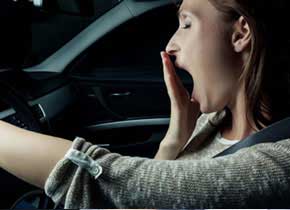
#27. If you feel drowsy while driving, you should:
Stop driving when you feel drowsy. Do not try to fight it. Pull off the highway at the first rest stop or service area. A cup of coffee and a bit of stretching may be enough to wake you.
If you are really sleepy, get off the highway and take a nap.
Remember, drowsiness is one of the greatest dangers in interstate highway driving.

#28. Regulatory road signs are normally:
Black and white (or red and white) are used for regulatory signs.

#29. What does this sign mean?
Low Clearance Ahead.
Vehicles or loads higher than the clearance shown cannot go under the structure ahead.

#30. Driving at night with parking lights instead of headlights is:
Do not drive a vehicle with only the parking lights on.
According to state law, headlights (not parking lights only) must be turned on from a half-hour after sunset to a half-hour before sunrise and during other periods of limited visibility when you cannot see clearly for at least 500 feet. Alabama law also requires that headlights be turned on when the windshield wipers of the vehicle are in use because of rain, sleet, or snow.
Alabama Permit Practice Tests for the Instruction Permit
Key numbers for the official Alabama written test:
| Number of Questions: | 30 |
| Correct answers needed: | 24 |
| Passing score: | 80 percent |
| Time limit: | n/a |
| Earliest retest upon failure: | 0 days (new fee) |
Getting Your First Learner’s Permit
If you are at least 15 years, you can apply for your first Alabama Learner License (a.k.a. Learner’s Permit).
A permit is the first step in the Alabama Graduated Driver’s License (GDL) program. With the permit, you can practice driving together with a supervising parent, legal guardian, or a person who is 21 years and holds an Alabama driver’s license. You can also drive together with a certified driving instructor, and the supervising person must sit in the front seat beside you.
Before Alabama Law Enforcement Agency (ALEA) issues a Learner License, you must pass a vision and written knowledge test.
1 Start by Studying the Driver Manual

Questions on the written knowledge exam are taken from the information in the Driver Manual. Everything you must learn to pass the exam is found in this manual.
You should read it and ensure you understand Alabama laws, safe driving, common road signs, traffic signals, and what to do in case of an accident.
You can get a copy from Driver’s License Offices or download a pdf-version online .
You are unlikely to pass the exam without studying the manual, so don’t skip this step. If you fail the test, you must pay the fee and wait in line again.
2 Use Practice Tests – They Help You Learn Faster
Each permit practice test has 30 questions from a large pool of questions. The tests help you prepare for the exam and tell you if you are ready for the actual exam or not.
You can take as many practice tests as you want. There are no limits and no fees. Aim for a full score on a handful of practice tests before you attempt the actual knowledge examination.
Remember, every attempt requires a new testing fee (currently $5.00).

3 Be Active
Cramming the manual and taking endless practice tests may help you pass the knowledge exam, but it will not help you retain the information at the end of the day.
To be a safe driver, you should use a strategy that helps you gain real knowledge that sticks over time. Such a strategy includes a focus on active learning.
By applying new knowledge in your everyday life, you stimulate the learning parts of your brain even more. Talk about what you are studying, write about it, relate it to things you already know, and try to apply it to daily situations. [ Read more ]
What is an Alabama Graduated Driver’s License?
Alabama Graduated Driver’s License (GDL) is a program that allows young drivers to gain driving experience through a step-by-step learning model.
The program has three stages:
Learner License (allows practicing with a supervising driver)
Restricted Driver’s License (allows driving without supervision but with some restrictions)
Unrestricted Driver’s License (full driving privileges)
Stage I: The Learner License
You must be 15 years old to apply for an Alabama Learner License.
You bring the necessary documents that show your full name, date of birth, and social security number. Non-citizens must show proof of legal presence in the United States. If you are under 19 years, you must also present a current Student Enrollment/Exclusion Form. You get the form from your school or any driver’s license office.
At the driver’s license office, you must pass a vision exam, pay a testing fee, and complete the written knowledge examination. If you pass the examination, you pay a license fee, and the examiner issues a learner’s permit.
With the permit, you can practice driving when accompanied by a parent, legal guardian, or licensed driver at least 21 years old. You may also drive when accompanied by a licensed or certified driving instructor.
When you drive, you must always have your Learner’s License with you, and a supervising driver must always sit beside you in the front seat. Under no circumstances may you practice driving without a supervising driver.
You must hold the Learner License for at least six months before moving to stage II.
Stage II: The Restricted License
You must be 16 years old to qualify for an Alabama restricted driver’s license.
A parent, grandparent, or legal guardian must approve your application.
To be eligible, you must have held a Learner License for at least six months and show a log that certifies that you completed 30 hours of driving or proof of a completed Driver Education Course.
You are now ready for the road skills examination. If you pass, the examiner will issue a restricted driver’s license.
The restricted driver’s license will allow you to drive alone but with certain restrictions.
With a few exceptions, you cannot drive alone between midnight and 6 a.m.
You cannot carry more than one passenger in the vehicle who is not a parent, legal guardian, or immediate family member.
The use of any handheld communication devices while driving is also prohibited.

Stage III: The Unrestricted License
An unrestricted or full driver’s license allows you to drive alone without special restrictions.
You must be at least 17 years old to get an unrestricted license.
If you are 17 years, you must hold a stage II restricted license for at least six months before applying.
If you are 18 years, you can bypass the stage II restricted license requirement.
More about the Alabama Graduated License Program
The program does not apply to individuals who are:
18 years or older
17 years or who have had valid driver’s licenses for six months or longer
16 years or older who are married and considered the head of household.
legally relieved of minority status (the state or period of being below the legal age).
Frequently Asked Questions about the Permit Test and GDL
How many questions are on the Alabama written test?
The Alabama written test for an instruction permit or driver's license has 30 questions. The passing score is 80 percent. You must correctly answer at least 24 questions to pass.
What is the passing score on the permit test in Alabama?
The passing score on the Alabama permit test is 80%. You must correctly answer at least 24 questions on a written test with 30 questions.
Can I take the permit test in another language?
The written knowledge test is available in the following languages:
- Arabic
- Chinese
- English
- Farsi
- French
- German
- Greek
- Japanese
- Korean
- Russian
- Spanish
- Thai
- Vietnamese.
Can I take the Alabama knowledge test from home?
No, ALEA does not allow any online testing from your home. You must visit a licensing office to take the knowledge test.
Is the Alabama permit test hard?
Alabama does not publish official knowledge test failure rates. Test takers, however, grade the difficulty as moderate to hard.
What is on the Alabama written permit test?
The 30-question test spans over common road signs, traffic signals, safe driving techniques, impaired driving, accident avoidance, and Alabama licensing laws.
Can I trust the practice tests?
Licenseroute,com has published online practice tests since 2008. Tests are reviewed and updated on a regular basis.
Answers to all questions are found in the Driver Manual and you should always compare the information when in doubt. When new laws are introduced, it may take some time before manual, tests, and practice tests are updated to reflect the changes.
If you find such inconsistency, please let us know.
What happens if I fail the permit test in Alabama?
If you think you are ready to take it again, you can do so the same day depending on availability. You must pay a testing fee ($5) each time you take the test.
What happens if I pass the Alabama permit test?
If you are applying for a learner license and pass the knowledge test, the examiner will issue your learner license which allows you to start driving together with a supervising driver.
At what age can I apply for the Alabama Learner License?
You must be at least 15 years old to apply for the Alabama Learner License (Learner Permit). This license allows you to practice driving together with a supervising driver.
At what age can I apply for the Alabama Restricted License?
You must be at least 16 years old to be eligible for a restricted Alabama driver license. You must hold a learner license for at least six months (if under 18 years) and pass a road skills test before ALEA issues the license.
Can I drive alone with a Alabama Learner License?
No. You may only drive when accompanied by a parent, legal guardian or licensed driver who is age 21 or older and occupying the front seat beside you.
Can I drive alone with a Alabama Restricted License?
Yes, the restricted license allows you to drive without supervision. You must have permission from parent, grandparent or legal guardian to be eligible for a restricted Alabama driver license.
You cannot drive alone during the hours of midnight to 6 a.m. and you must not drive with more than one passenger in the vehicle other than parents, legal guardians or family members.
At what age can I apply for a regular and unrestricted Alabama Driver License?
You must be at least 17 years old.
At age 17, you must have held a restricted (stage II) license for at least six months before applying.
If you are 18 years or older you can apply immediately for the regular driver's license (passing score on road skills exam is required).
