
West Virginia Written Test Practice – Questions & Answers
Results
Yes, this is a passing score. Do you want to try another test?
This is not a passing score. Do you want to try again?




#1. When is it safe to pass a vehicle stopped at a crosswalk?
Passing is prohibited when a vehicle in front of you has stopped at an intersection to allow a pedestrian to cross.

#2. A road sign with a round shape means:
A circular sign is used to warn that there is a railroad crossing ahead.

#3. Motor vehicles registered in West Virginia must be inspected each year by:
West Virginia requires a yearly inspection of all vehicles to ensure they are in safe driving condition. Your vehicle must be checked at an inspection station displaying an official state inspection station sign.

#4. When must you use your headlights?
Turn on your headlights from sunset to sunrise, during fog, smoke, rain, or at any other time when persons and vehicles cannot be seen clearly at a distance of 500 feet.
At night and on overcast or rainy days, you will need all the light possible to see and be seen properly. If you turn on your headlights a little early, you will help other drivers see you.

#5. You must always keep proof of your liability insurance:
A certificate of insurance or other proof of insurance must be carried in your vehicle at all times along with a valid vehicle registration card. In the event of a crash, you must present this certificate or other proof to any investigating officer. You must also show the certificate at the time of annual vehicle inspection.

#6. When must you stop at a railroad crossing?
You are required to stop when:
- The electrical or mechanical warning devices are flashing.
- The crossing gate is lowered.
- A human flagger is warning of an approaching train.
- An approaching train is clearly visible and is in close proximity to the railroad-highway grade crossing.
Do not proceed until you can do so safely.

#7. Emotions affect your driving. If overly worried, excited, afraid, or angry, it is a good idea to:
Sometimes you may experience emotional states of anger, worry, or fear. You should attempt to control these emotions and gain self-control before driving.

#8. If the pavement is wet as you approach this sign, it is dangerous to:
Slippery when wet.
This section of highway is more slippery than other roads when wet. Reduce your speed.

#9. What does this sign mean?
A yield sign is a downward pointing triangle. It is red and white with red letters. You will see no other signs of this shape on the highway.
Slow down and give vehicles crossing your path the right-of-way. If the way is clear, you may move forward slowly without stopping. Yield signs are usually placed where auxiliary roads lead into major roads.

#10. What does this sign mean?
Sharp turn. The road will make a sharp turn. The turn is too sharp to take at the regular highway speed. An advisory speed sign may be attached.

#11. A pedestrian has entered a crosswalk where there are no signs or signals. Who has the right of way?
You must yield to pedestrians in a crosswalk, or when they are crossing a sidewalk that crosses an alley entrance or driveway. Always yield to pedestrians before making a turn.
Drivers must use extreme care to avoid colliding with a pedestrian, especially in areas where special hazards exist, such as school zones, bus stops, playgrounds, and parks.

#12. When making a right turn you must:
Make sure it is safe to turn. Check traffic to the front and rear of your vehicle and watch for pedestrians.

#13. What will happen if you are issued a citation for the use of a cell phone while holding a level 1 instruction permit?
If a citation is issued for the use of a cell phone on a Level 1 permit or Level 2 license, you must begin the conviction-free time period over.
#14. At a mailbox served by a carrier using a motor vehicle for daily deliveries, parking is not allowed within the following limit:
Parking is not allowed within 20 feet of any mailbox served by a carrier using a motor vehicle for daily deliveries.

#15. An important reminder for safe night driving is to:
Overdriving headlights is a common and dangerous practice. You should never drive so fast that you cannot stop within the distance you can see ahead with your lights.

#16. You want to overtake the vehicle ahead of you. Which pavement marking tells you that you are allowed to pass?
A normal broken yellow line tells you that passing with care is allowed.
Remember, broken lines are permissive in character. Solid lines are restrictive in character.

#17. A large truck turns right onto a street with two lanes in each direction. The truck:
Large trucks cannot turn to the right without first swinging to the left, or to the left without swinging to the right. Never pass a truck on the right during a turn.

#18. A solid green signal light means:
Circular green means go. Drivers facing this signal may enter the intersection and go straight through, turn right, or left, unless other traffic control devices (signs or pavement markings) prohibit certain movements. All turns must be made in accordance with accepted right-of-way rules. A driver who is facing a circular green indication and wishes to turn left must yield to oncoming vehicles.
Remember, never block an intersection or crosswalk with your vehicle.
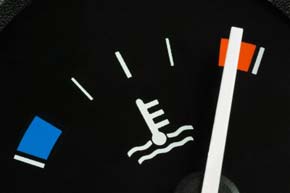
#19. With an overheated engine it is important that you do not:
If the warning light or gauge shows the engine is overheating, pull off the road and turn the engine off. Do not remove the radiator cap until the engine has cooled off .

#20. When approaching a stopped school bus picking up children and traveling in the opposite direction on a two-lane roadway with a center turning lane, you must:
On all undivided highways (without a median), traffic in both directions must stop at least 20 feet from a stopped school bus that has its red lights flashing. You must not pass the bus until the lights are turned off or the bus starts moving.

#21. The best way to see problems early and avoid last-minute moves when driving is to:
Check traffic and mirrors regularly. As a good driver, you should always be aware of where you are, and pay attention to developing traffic problems. Constantly observing your surroundings, to the front, side, and rear of your vehicle, helps you to see problems that may cause you to change speed or roadway position.

#22. What does this sign mean?
Keep Left.
These signs are posted between highway lanes that are divided and placed at openings in the dividers where streets intersect with the highway. They are to remind you which side of the divider you belong on.

#23. When may you drive faster than a maximum speed limit?
West Virginia law prohibits driving at a speed that is greater than reasonable and prudent for existing conditions. This is known as the basic speed law.
Remember, posted speed limits do not tell you at what speed to drive. They only tell you what the maximum legal speed is under ideal conditions. Slow down during traffic, weather, roadway hazards, or other conditions that limit visibility or stopping distance.

#24. When should you stop on an interstate?
In general, you may never stop on an interstate except in an emergency. You must, however, always follow any lawful order or direction of any law enforcement officer or any fireman at the scene of a fire who is directing traffic.

#25. The blood alcohol level at which it is illegal for any person 21 years or older to drive is:
For drivers over the age of 21, it is against the law to drive if the blood alcohol concentration is 0.08% or higher. For drivers under the age of 21, it is against the law to drive if it is 0.02% or higher.
The West Virginia Written Knowledge Test
Key numbers for your official knowledge examination in West Virginia:
| Test Questions: | 25 |
| Correct answers needed: | 19 |
| Passing score: | 76% |
| Time limit: | 18 minutes |
| Earliest retest if you fail: | 7 days |

Get Ready for the West Virginia DMV Test
This practice test will help you prepare for the West Virginia DMV Test and pass the examination on your first try.
Yes, passing the driver’s knowledge examination on your first try is possible despite the estimated 30% first-time fail rate.
In short, you will have 18 minutes to complete 25 multiple-choice questions. You must correctly answer 19 questions, with a passing score of 76%, slightly lower than the average of 80% in other states.
Your route to success has two cornerstones, the Licensing handbook, and multiple practice tests.
Plan to work on both for at least one week.
1 The Licensing Handbook
Get a copy of the West Virginia Driver’s Licensing Handbook.
The handbook is usually updated once every year, so make sure you have the latest version. Even if the rules and questions on the test don’t change very often, you want to be updated on the newest information from West Virginia DMV.
If you are comfortable reading the book on your computer, tablet, or phone, you can download a PDF-version from the DMV website .
The handbook is an easy read, even if you should expect the reading time to be about six hours.
The book doesn’t give you any hints on what questions you should expect on the test. Many details are mentioned briefly and are easy to miss, which is why you need the practice test.
2 The Practice Test
This West Virginia practice test has 25 random questions drawn from a large pool of exam questions, and it will look different each time you start over.
You can take tests as often as you need to prepare for the exam.
It will cover all the essential items from the licensing handbook.
Instant feedback will tell you if your answer is correct or not. Short explanations will help you understand the correct answers.
It is designed for West Virginia, meaning you study the items that West Virginia DMV may add to your knowledge exam.
Remember that the practice test is intended as a learning tool. You should not use it instead of reading the handbook. You need to work with both.
3 Review Your Wrong Answers
When you miss a question on the practice test, you should pay extra attention to that question.
Ask yourself why you missed it. Lack of knowledge? Was it something you skipped in the handbook? Or did you not read the question carefully enough?
You will learn much from your mistakes by focusing on why you made them.
Encourage yourself to give it time, think through each question, and work on expanding your knowledge. Try to think beyond the examination.

What You Should Know about the Exam
You are expected to complete the knowledge exam within 18 minutes.
If you have prepared with our practice test, you will finish the examination in 5-10 minutes. Just be sure to read all questions at least twice. Don’t rush through the test.
Ask for a test with audio support if you have difficulty understanding text by just reading. The examiner will lend you a headset if you ask for it.
WV DMV does not offer any oral tests. DMV employees are not allowed to read the questions to you, re-word the information, or provide additional help explaining questions on the test.
If you have trouble understanding English, the West Virginia test is also available in Hindi, Spanish, and Vietnamese. For other languages, you are allowed to bring an interpreter.
DMV provides sign language interpreters.
It is a closed-book test, so you cannot bring the handbook or any notes when taking the test. No cell phones, PDAs, blue-tooth devices, electronic devices, or similar will be permitted.
Is the West Virginia Permit Test Hard?
Even with a low passing score, the failure rate in West Virginia is around 30%. The difficulty level is graded “moderate.”
We believe that one reason is the use of outdated practices where more than one answer can be correct, which is the case when “All of the above” is one of the right answers.
But the main reason test takers fail the exam is lack of preparation.
If you fail the West Virginia knowledge test, you must wait one week before you are allowed to try again. You must also pay the test fee ($7.50) for each attempt.

Can I take the West Virginia Permit Test online?
Since 2021, DMV has offered the knowledge examination online from your home.
I am applying at a DMV office before the online test is unnecessary. Just register online, accept the terms, and pay the testing fee.
After you have passed the test, you visit your nearest DMV office with all your documents, and DMV will issue the permit.
If you are under 18 years, you must have a sponsor who supervises you during the test. The supervising adult must be at least 18 years of age and have a valid driver’s license from a U.S. state. The identity of the supervising adult will be validated during the registration process, and it will most likely be your parent or guardian, even if that isn’t necessary.
You cannot take the online test on a wireless phone.
Photo Credits
About the test – photo by Andrea Piacquadio
Cover photo by William Fortunato.
