
Texas DMV Written Knowledge Test Practice – Permit Test 2026




#1. Which of the following is a good example of defensive driving?
A defensive driver should:
- Stay alert and keep eyes moving to keep track of what is happening at all times.
- Look for trouble spots developing all around.
- Have a plan of action.
- Know the law requires drivers to protect each other from their own mistakes.

#2. When parking your vehicle parallel to the curb on a level street:
Do not park more than 18 inches from the curb or edge of roadway. You should be about six inches from the curb.

#3. What is the meaning of this sign?
You are near a school. Slow down, and prepare to stop suddenly if necessary. Watch for children.
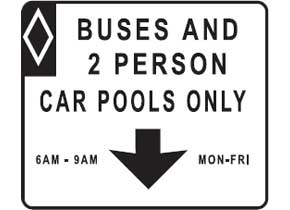
#4. Which of the following may use a lane marked with this sign?
High occupancy vehicle (HOV) lanes are identified by a white diamond painted on the roadway. Signs will identify the types of vehicles and the number of occupants required per vehicle to use the lane.

#5. When driving at night, you should:
A basic rule for safe night driving is to never outrun or overdrive your headlights.
Allow for more safety margins than you would during daylight. Remember, when you overdrive your headlights, you are driving at a speed making your stopping distance longer than the distance lighted by your headlights.

#6. Which road signs have an upside-down triangle shape?
The equilateral (downward pointing) triangle shape is exclusively used for yield signs.

#7. When approaching a stopped school bus with flashing red lights at a four-way intersection, you must stop:
If you approach a school bus from either direction and the bus is displaying alternately flashing red lights, you must stop. It is not necessary to stop when passing a school bus on a different road or when on a controlled-access highway where the bus is stopped in a loading zone and pedestrians are not permitted to cross.

#8. During an enforcement stop by a police officer, you should:
If you are stopped by law enforcement it is suggested you:
- Move the vehicle safely to the right of the road as soon as possible and stop.
- Place the vehicle in a parking position, set the emergency brake, turn the engine off, and activate the hazard warning lights.
- Remain in the car, lower the driver’s window, and wait for the law enforcement officer to give instructions.
- Keep your hands in clear view.
- Follow the instructions of the law enforcement officer.
- Require passengers to remain in the car unless other instructions are given by the law enforcement officer.
- Give the appropriate signals and safely return to the proper lane of traffic when released by the law enforcement officer.

#9. When you see this sign, you should:
The side road sign tells you that there is an intersection ahead. Another road enters the road you are traveling on from the direction shown. Watch for traffic from that direction

#10. When a traffic signal is showing a flashing red light, you must:
A flashing red traffic light has the same meaning as a stop sign. Stop completely before entering the crosswalk or intersection then proceed when you can do so safely. Vehicles on the intersecting road may not have to stop.
A green signal will not appear.

#11. A leak in the exhaust system can:
Beware of carbon monoxide poisoning. Cars produce carbon monoxide which is deadly gas. Make sure you are getting plenty of fresh air. Remember, the gas has no smell, taste, or color.
Do not:
- Leave the motor running in a garage.
- Leave vents open when following closely behind another car.
- Leave the motor running and the windows closed while the car is parked.
- Drive with a defective muffler or exhaust system.
- Use the heater or air conditioner in a parked car with the windows closed.

#12. A pedestrian hybrid beacon signal is showing steady red lights. What signal will follow next?
A pedestrian hybrid beacon is a special type of hybrid beacon used with signs and pavement markings to warn and control traffic at locations where pedestrians enter or cross a street or highway.
Steady red lights mean you must stop at the stop line. At this point, the pedestrian receives a walk signal and may start crossing.

#13. When are you most at risk of drowsy driving?
Drowsiness is one of the greatest dangers in interstate highway driving. Stop often. Even if you are feeling well you should stop at least every two hours or every 100 miles.
All drivers should be aware of its danger and of the methods for fighting it.

#14. Car tires are worn-out and unsafe if the remaining tread depth is:
All vehicles are required to have tires in proper and safe condition with a minimum depth of 2/32 of an inch.
Place a penny into several tread grooves across the tire. If part of Lincoln’s head is always covered by the tread, you have more than 2/32 of tread depth remaining.

#15. If you are involved in a traffic crash, and someone is injured, it is generally wrong to:
Do not assume people are not injured simply because they say they are not. Send for skilled help as quickly as possible. Unskilled handling can do more harm than good.
Do not move a victim unless it is absolutely necessary. If a victim must be moved, get help, and try not to change the position in which the victim was found.
Stop serious bleeding with thick cloth pads, as clean as possible, apply with pressure by hand or by bandaging. Keep a victim comfortable. If it is hot, cool the victim and provide shade as much as possible. If it is cool, cover the victim with blankets or coats if the necessary and if available.
Never give injured persons anything to drink, not even water.

#16. What should you do after passing a large truck?
Be sure to move back only when you can see the front of the truck in your rear-view mirror. After you pass a truck, maintain your speed. Do not slow down.

#17. You see this sign attached to the back of a vehicle ahead. What should you do?
Be constantly aware of any vehicles that might be traveling at a much slower speed. Adjust the speed and position of your vehicle accordingly. Only pass the slow-moving vehicle when it is safe to do so.

#18. What is true about signaling before making a sudden stop?
Remember, the law requires that you give an appropriate signal before stopping or suddenly decrease your speed. You may use either signal lights (brake lights) or hand and arm signals. Make sure your signals can be easily seen by others.

#19. Unless otherwise posted, what is the speed limit on an interstate highway outside an urban district?
Unless otherwise posted, the speed limit on a highway numbered by this state or the United States, and outside an urban district is 70 mph.
Note that cities and counties have the authority to change speed limits. Texas Transportation Commission also has the authority to raise the speed limit on parts of the state highway system.

#20. If you see this sign in front of you, it tells you that:
Road or street ahead is for one-way traffic. Do not drive into it.
You will see this sign at roadway openings that you should not enter, such as exit ramps where you would be going in the wrong direction, crossovers on divided roadways, and at numerous locations on one-way streets.
Remember, the sign is square with a white horizontal line inside a red ball. It is not circular!

#21. The following motor vehicle equipment is prohibited:
The following equipment is not allowed: a radar interference device designed, manufactured, used, or intended to be used to interfere with, scramble, disrupt, or cause to malfunction a radar or laser device used to measure a vehicle’s speed.
If sunscreen or window tinting is used, it must comply with the appropriate state regulations for your vehicle make and model.

#22. On cold, wet days, which of the following roadways is most likely to hide spots of ice?
On cold, wet days shady spots can be icy. Snow melts more slowly in shady areas. There may also be ice on bridges when the rest of the pavement is clear.

#23. Where will you typically see a sign like this?
Two-direction Arrow. You are approaching a T-intersection and must turn left or right. Be prepared to yield the right-of-way at the intersection if necessary.

#24. You approach a roundabout with no traffic. You should:
To drive in a modern roundabout, follow these simple steps:
- slow down as you approach the intersection
- yield to traffic already in the circle
- enter the circle and follow the loop in a counterclockwise direction
- make a right turn to exit the roundabout

#25. When can you drive off the pavement to pass another vehicle on the right?
Do not pass on the right by driving off the paved portion of the highway. You may pass on a PAVED shoulder when the vehicle you are passing is slowing or stopped on the main traveled portion of the highway, disabled, or preparing to make a left turn.

#26. If you run off the pavement, you should:
If you run off the pavement:
- Do not hit the brakes suddenly and hard.
- Grip the steering wheel tightly.
- Take your foot off of the gas pedal.
- Use your brakes carefully.
- Do not swing back onto the pavement. Wait until your speed is reduced.
- Check the traffic behind you, then carefully drive back onto the pavement.

#27. If you see a pedestrian with a white cane attempting to cross the street, you must:
Be alert to pedestrians guided by an assistance animal or carrying a white cane. Give them the right-of-way, even if the traffic signals or other right-of-way rules are not in their favor. Do not honk your horn.
Remember, you must take the necessary precautions to avoid injuring or endangering a pedestrian crossing or attempting to cross the street. You must bring your vehicle to a full stop if injury or danger can only be avoided by that action.
In many states, blind pedestrians have an absolute right-of-way.

#28. A two-way special left turn lane should be used for:
The center lane is only used for vehicles turning left, not for passing or overtaking. The only time a vehicle should enter the center lane is at a point where the vehicle will have time to slow down or stop to make a safe left turn. This lane should never be used for passing or as a through traffic lane.
This lane is marked on each side by solid yellow and broken yellow lines.

#29. To back your vehicle safely you should:
Back slowly. Your vehicle is much harder to steer when you are backing.

#30. The legal drinking age for alcohol is:
In Texas, a minor is any individual who is under 21 years of age. A minor may not purchase, attempt to purchase, consume, or possess an alcoholic beverage.
The Texas DMV Written Knowledge Test
Key numbers for the official learner’s permit and driver’s license written test in Texas:
| Test Questions: | 30 |
| Correct answers needed: | 21 |
| Passing score: | 70% |
| Time limit: | No |
| Earliest retest if you fail: | Next day |

About This Written Test Practice
This written test practice is designed to help you pass the Texas knowledge examination for a learner’s permit or full driver’s license.
It is a random practice test with 30 questions from a large pool of test questions and answers. You can take the test several times and expect a different quiz each time.
After each question, you will get instant feedback on whether your answer is correct. There are also brief explanations to help you understand the correct answer. At the end of the test, you will see your score.
The real Texas permit test has a passing score of 70% (21 correct answers). On the practice test, you should score 100% on several tests. It gives you a good margin on the actual examination.
The test is entirely free, and no registration is necessary.

The Real TX DPS Examination
If you are enrolled in an authorized driver education course, you can generally take the written test as part of your education.
You can also visit a DMV Driver Licensing office and take the test.
Texas DMV does not offer online testing from your home. So, this practice test is not an official test that entitles you to a learner’s permit or Texas driver’s license. As you probably already understand, Licenseroute.com is not affiliated with Texas DPS.
When you take the test, you will get 30 random test questions. To pass, you must answer at least 21 questions correctly.
You can skip questions you aren’t sure about (no more than 9). If you don’t reach 21 correct answers on the remaining questions, the skipped ones will return at the end, but if you get a passing score of 70%, you will never see the skipped questions again. The test ends after 21 correct answers.
Should you miss the target of 70% and fail the exam, you can retake it the next day. You can make three attempts within a 90-day window. If you fail a 4th time or exceed the 90-day limit, you must submit a new application and pay the fee again.
Texas written tests are only available in English and Spanish. If you speak Spanish, you must understand enough English to recognize the meaning of some of the road signs.
Interpreters are allowed but not paid for by Texas DMV.
You cannot bring books, manuals, papers, or electronic devices to the testing area.
Must I Take a Driver Education Course to Get a Driver’s License in Texas?
Yes, all first-time applicants under 25 must complete a driver’s education course before Texas DMV issues a permit or driver’s license.
You have these options:
Enroll in a driver education school
Enroll in a parent-taught driver education course with an approved parent-taught course provider
Complete driver education at a public school, education service center, college, or university
The classroom phase of any driver education course must consist of at least 32 hours (which must stretch over at least 16 days). The course must also contain at least 7 hours of behind-the-wheel driving and 7 hours of in-car observation.
Before the DMV issues your initial learner license, you must complete the first six hours of the driver education classroom instruction (concurrent method) or all 32 hours (block method).
Ensure you have your certificate of completion (DE-964) before applying for your learner license.
Is the Texas License Test Hard?
Texas DMV does not share failure rates on the written knowledge test. Estimates suggest that only one out of four (25%) first-time test takers fail the Texas written examination, which makes the exam one of the easiest to pass.

Our surveys also show that very few of our users fail the test. But if you DO fail, don’t give up. You can nail it with more practice and help from a driving instructor, parent, or friend. Just avoid some of the worst study tactics !
Even if the Texas Driver Handbook is a tedious read, you should consider it your best friend. Everything you need to learn is found in this handbook.
