
New York State Permit Practice Test – 2026




#1. The entrance ramp of an expressway:
Unless there is a STOP or YIELD sign or traffic light on the entrance ramp, use the ramp to accelerate to expressway speed and blend with traffic. Signal, then look over your shoulder for traffic already on the expressway. If necessary, slow down to safely merge into traffic.

#2. Unless there is a No Turn on Red sign, you may normally turn right at a red light if:
A red signal light means stop. You can make a right turn against a red light after you stop and yield to pedestrians, bicyclists, and vehicles close enough to be a hazard. Make the right turn only when it is safe. Do not turn if a no turn on red sign is posted.
You are not allowed to turn on a red light in New York City unless a sign that permits turning is posted.

#3. If you are over 21 years old, and are convicted of an alcohol or drug-related driving violation in any other state, your driving privilege:
If you are over 21 years old, and are convicted of an alcohol or drug-related driving violation in any other state or the provinces of Ontario and Quebec in Canada, your New York State driver’s license will be revoked for at least 90 days.

#4. If your car starts to skid, what is the most common cause?
Unsafe speed is the most common cause of skidding accidents.

#5. When stopped, you should keep your front wheels pointing straight unless you are:
If there is a curb, turn your steering wheel completely away from it if your vehicle faces up the hill, or completely toward the curb if your vehicle faces down the hill. If your vehicle begins to move, the wheels should stop the vehicle at the curb and prevent a move down the hill. This method works best where the curb is high. If there is no curb or a low one, turn your wheels completely toward the nearest side of the road no matter what direction your vehicle faces. If your vehicle does start to move, it will move away from the street and traffic.

#6. If red lights are flashing at a railroad crossing, you should:
If red lights are flashing at a railroad crossing, you must always stop. Remain stopped until the train passes by and the lights stop flashing.

#7. When is it legal to exceed the speed limit to pass another vehicle?
You must never exceed the speed limit to pass another vehicle.

#8. Which sign is rectangular-shaped?
REGULATION SIGNS normally are white rectangles with black letters or symbols, but some are different shapes, and some can use red letters or symbols. Keep Right and Do Not Pass are some examples.

#9. Your high-beam headlights will normally let you see about:
Your headlights cover about 350 feet ahead. It is important that you drive at a speed that allows you to stop safely within that distance.
#10. Eating before or while you drink:
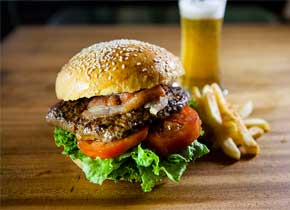
Eating before or while you drink helps slow down alcohol absorption. It will not prevent you from getting intoxicated or being impaired.

#11. You can park and leave your car:
Never park your car on a bridge, in front of a public or private driveway, or in a crosswalk.

#12. You must come to a full stop at a YIELD sign:
A yield sign is a red and white triangle with red letters. It means that you should decrease speed as you reach the intersection. Prepare to stop and yield the right-of-way to vehicles and pedestrians in or heading toward the intersection. You must come to a full stop at a yield sign if traffic conditions require it. When you approach a yield sign, check carefully for traffic, and be prepared to stop.

#13. This hand signal means:
Right turn – left arm extended, with elbow bent upward, at about a 90-degree angle.

#14. Always look carefully for motorcycles before you make a left turn because:
Many drivers who are involved in a crash with a motorcyclist report that they did not see the motorcycle. Motorcycles, when compared to other highway users, are smaller. A motorcycle’s smaller size makes it seem much farther away, and makes it difficult to judge how far away they are or how fast they are going. Another factor is that drivers may not see motorcycles simply because they don’t look for motorcycles. It’s human nature to look for something specific. A new driver may be told to look for cars (and trucks) before going through an intersection – and that is precisely what s/he will look for. All drivers need to train themselves to look for motorcycles and to share the road safely with them.

#15. What does this sign mean?
The highway ahead is divided into two one-way roadways.
Divided highways have a center strip that separates traffic going in opposite directions. The sign is posted before a divided highway begins.

#16. When driving a car with airbags, you should grip the steering wheel by:
Keep your hands on opposite sides of the steering wheel, at the 3 and 9 clock positions, to keep them away if the airbag engages.

#17. To avoid getting tired on a long trip, you should:
Schedule regular stops for every 100 miles or 2 hours.

#18. This sign means:
Merge sign. You are approaching a point where other traffic lanes come together with your lane. Watch for traffic from that direction.

#19. Where there is no bicycle lane, where on the road must a bicyclist ride?
They must ride in a bicycle lane, if available. Where there is none, they must remain near the right curb or edge of the road or on a right shoulder of the road, to prevent interference with other traffic.

#20. When are two regular solid white lines used as pavement marking?
Where crossing the lane line markings is prohibited, the lane line markings consist of two normal solid white lines.
New York DMV Knowledge Test
Quick facts about your DMV driver’s license and learner’s permit test in the State of New York:
| Number of Questions: | 20 |
| Correct answers needed: | 14 |
| Passing score: | 70 percent |
| Time limit: | None |
| Earliest retest upon failure: | Same day |

500 Practice Questions for Your New York Driver’s License
With 20 random practice questions from a large pool of exam questions, you can prepare for your NYS DMV test and pass the first time.
Use the New York Driver’s Manual and its study questions together with this practice test, and you will likely pass the exam the first time.
After each question on this practice test, you will know whether your answer was correct. There are also short explanations if you get something wrong.
As you probably already know, all exam questions are based on the New York Driver’s Manual information. You can get a copy from your DMV office or download a PDF-version online. Read the manual before you start practicing. It would be best if you had a good understanding of the content before you take the test and before you start driving.
This practice test does not include all questions that may appear on your test but covers all essential items. If you get a full score on more than a handful of tests, you will probably pass the actual exam easily, and it is better than any other New York permit test cheat sheet.
New York Driver’s License and Permit Test
The real NY knowledge exam consists of 20 multiple-choice questions. To pass the exam, you must correctly answer 14 questions and reach a passing score of 70%. In addition, you must get two of the four road signs questions right. If you miss three road signs, you will fail the exam, regardless of your score on the other questions.
There is no time limit when you take the test, but it rarely takes more than 5-10 minutes to complete.
You have a lot of time to carefully read every question and the choices. There are no trick questions, and only one answer is correct.
Should you fail the test the first time, you can retake it the same day if the examiner allows you to. You can take it as many times as you need to pass. But if you fail, there are many things you have missed. To improve your chances of becoming a good driver, you should wait a few days and study the manual again before you make another attempt.
There is no new fee when you retake the test.
Teenagers will usually take the test as part of a driving course at high school. This online test is only available in Spanish and English.
You must visit a DMV office to take the test in any other language. The regular knowledge test is available in the following languages:
Arabic
Bengali
Bosnian
Chinese
Greek
Hebrew
Italian
Japanese
Nepali
Polish
Russian
Spanish
Is the NY Knowledge Test Hard?
The knowledge test in the State of New York is known to be one of the easiest in the United States. It has 20 questions, the passing score is 70%, and the failure rate is about 10%.
The New York Driver’s Manual gives many study questions to help you understand what will appear on the exam.

First-time Applicants under 18 Years
Young and newly licensed drivers are much more likely to be involved in crashes than experienced drivers, so New York and other states have adopted Graduated Driver Licensing (GDL) laws.
The GDL system allows drivers in this at-risk age group to gain experience and gradually display their safe driving ability.
There are three phases of licensing in the GDL system:
| Phases | Age Requirement |
|---|---|
| Step 1: Junior Permit | 16 years |
| Step 2: Junior License | 16 years, six months |
| Step 3: Full Driver’s License | 17 years |
All first-time applicants under 18 must follow the GDL program and complete a pre-licensing or driver education course (also called the “5-hour course”) before being eligible for a Junior License.
New York Junior Permit
The Junior Permit, also known as a learner’s permit, is the first step in the GDL program. To get your learner’s permit, you must:
be at least 16 years or older,
apply in person at a DMV office,
show proof of full name, age, residence, and Social Security Number,
have parental approval if under 18 years, and
pass a vision screening and knowledge test.
Parental consent is required unless you are 17 and have a Driver Education Certificate of Completion.
With a Junior Permit, you can start your driving practice, and you may drive only under the supervision of a licensed driver.

During daylight hours (5 am – 9 pm), you can drive under the supervision of any driver who is 21 years or older and holds a New Your Driver’s License. The supervising driver must always sit in the front seat beside you.
At night (9 pm – 5 am), you can only drive under the supervision of an NYS license holder who is a parent, guardian, driver education teacher/driving school instructor, or a person who is 21 years or older and approved by your parent or guardian.
If the supervising driver is not a parent or guardian, you can only drive with one passenger under 21 years unless passengers are immediate family.
Before Moving on to Phase Two
Before you can move on to the next phase, a Junior License, you must:
hold your permit for at least six months,
complete the 5-hour pre-licensing course,
complete 50 hours of driving practice, of which 15 hours must be at night, and
pass a road skills test.
New York Junior License – Restrictions
The Junior License, a probationary license, is the second step in the GDL program. This is when you can start driving independently without a supervising driver.
Night Curfew
You may always drive without supervision from 5 am to 9 pm. In addition, you may drive at night (9 pm to 5 am) if you drive to and from work or school activities. Remember that you must have proper documentation showing that you must drive to and from these activities. You cannot drive unsupervised at night while you work, to and from social events, sports training, etc.
Passenger Restrictions
You can drive with only one passenger under 21 years unless passengers are immediate family or unless you drive with a “supervising driver.”
All Passengers Must be Restrained
A safety belt or child safety seat must properly restrain all occupants.
Area Restrictions
If you have a Class DJ or MJ junior license, you cannot drive within the five boroughs of New York City under any circumstances.
For more about driving restrictions in New York, visit dmv.ny.gov
No Cell Phone Use
You cannot use a hand-held mobile telephone or portable electronic device while you drive. Illegal activity includes holding a portable electronic device and
talking on a handheld mobile telephone,
text messaging,
browsing webpages,
viewing, taking, or transmitting images, and
playing games.
Remember, using any electronic device while driving is against the law for all drivers.
New York Driver’s License
You can apply for a full license when you are 17 or older, have your Student Certificate of Completion from an approved driver education course, and pass the road skills test.
If you don’t apply for your license at 17 years, you are still considered a junior license holder and must continue to follow GDL restrictions.
At age 18, your junior license is automatically converted to a full driver’s license.
